What DeepMind published
Google DeepMind and Google Quantum AI say teams of Gemini 4 agents have improved well-known quantum algorithms into markedly cheaper quantum circuits, with every result formally proved in the Lean theorem prover. The work, announced on DeepMind's blog on Nov 23 and posted as the paper "Discovering formally verified quantum programs with AI" (arXiv:2611.09822), targets circuits for simulating fusion energy, chemistry and drug-metabolism enzymes — applications whose resource demands are expected to exceed the first error-corrected quantum computers.
The provenance is again the story, a week after a Gemini 4 Carbon harness claimed a proof of Hadwiger's covering conjecture. Here the agents did not just find candidates: they synthesized novel quantum programs against formal problem specifications inside a Lean library, verifying both correctness and cost, and DeepMind says it is open-sourcing the library, the problem specifications and the verified solutions.
The numbers
The headline result is a quantum circuit computing an important property of inertial-confinement fusion — a reaction method that uses lasers to compress hydrogen fuel until ignition. The agent teams cut the required computing cost, a metric combining required qubits and operations, by 11.8x, and lowered required memory from 5,650 to 4,338 error-corrected qubits. (The paper's abstract rounds the fusion improvement to 12x.)
For a common light-sensitive molecule, quantum simulation became 8x cheaper. For Cytochrome P450 — the enzyme that breaks down most human medicines and matters for drug design — the agents found a 2.5x improvement and cut memory from 481 to 333 qubits. A fundamental search primitive also moved: a specific implementation of Grover's algorithm ran 2.57x faster, and arcsin, a common arithmetic routine used to load numbers into quantum states, became 290x cheaper.
How the agents worked
For each problem, DeepMind tasked separate, independent agent teams with finding algorithmic improvements. Ideas were verified in Lean before entering a shared notebook, and every four hours agents from each team met at a virtual conference to trade, debate and compare ideas. As more effective ideas accumulated, the computational cost fell until the experiment finished.
AI-assisted analysis
Machine-synthesised- Fact
Google DeepMind and Google Quantum AI used teams of Gemini 4 agents to improve well-known quantum algorithms into cheaper quantum circuits, with every result proved in the Lean theorem prover.
Source: Google DeepMind(opens in a new tab) - Figure
For a quantum circuit computing an important property of inertial-confinement fusion, the agent teams cut the computing cost — a metric combining required qubits and operations — by 11.8x and lowered required memory from 5,650 to 4,338 error-corrected qubits.
Source: Google DeepMind(opens in a new tab) - Figure
Further results: an 8x cost cut for simulating a common light-sensitive molecule, a 2.5x improvement for Cytochrome P450 with memory down from 481 to 333 qubits, a 2.57x speedup for a specific implementation of Grover's algorithm, and a 290x speedup for the arcsin routine.
Source: Google DeepMind(opens in a new tab) - Fact
For each problem, separate independent agent teams proposed improvements that were verified in Lean before entering a shared notebook; every four hours, agents from each team met at a virtual conference to trade, debate and compare ideas.
Source: Google DeepMind(opens in a new tab)
Synthesised by PulseGrid's editorial AI from the sourced claims in this article and reviewed by PulseGrid AI Desk. How we use AI.
Partner content · paid placement
Sponsored tile inventory: Q1 2027
Native tiles in the in-feed carousel and the article block, sold only with the visible Sponsored / Partner Content label. Slot sizes, positions and advertiser terms are published on the advertise page. No newsroom byline is ever attached to partner copy.
The paper describes agent teams collaborating through wikis and organized conferences, synthesizing programs against formal specifications in a Lean quantum-program library. The human role was to set research direction by choosing the problems and to supervise progress: DeepMind credits "the combination of human and artificial intelligence at scale, under the rigor of mathematical proof" with letting researchers design algorithms that today's classical and quantum computers cannot test.
Why proof-checking matters
Resource-intensive quantum circuits cannot be tested on classical computers or today's small quantum processors, so mathematical proof is the only available trust layer — and the Lean artefacts make each claim re-checkable by anyone. That is the same credibility pattern as the Lean 4 formalisation attached to last week's Hadwiger preprint: verification is becoming the acceptance layer for machine-found results.
The improvements are significant but not yet practical. DeepMind cautions that running the optimised algorithms in scientific simulations would still demand more computational resources than the first error-corrected quantum computers are likely to provide. The open-sourced Lean library is the more immediately usable output: a reusable framework for proof-checked quantum algorithm research.
What to watch
Independent review. The numbers are DeepMind's and the paper is fresh; the quantum-algorithms community has yet to weigh in on the baselines and cost model.
Generalisation. DeepMind says the same approach could accelerate other aspects of quantum computing research and scientific discovery more broadly — the next test is whether proof-checked agent teams deliver outside arithmetic and simulation primitives.
The cost of checking itself. Lean proofs are not free to produce or maintain; whether verified-output status becomes a standard expectation for AI-generated science is now a sociological question as much as a technical one.
Bottom line
Proof-checked AI search compresses work that once took years of manual design into experiments supervised at the problem-selection level. The honest framing is that these are optimised-but-still-huge circuits — the achievement is cheaper arithmetic for the quantum era, machine-verified end to end, not quantum advantage arriving early. If the open-source library gains adoption, the lasting product of the experiment may be the method rather than any single 290x number.
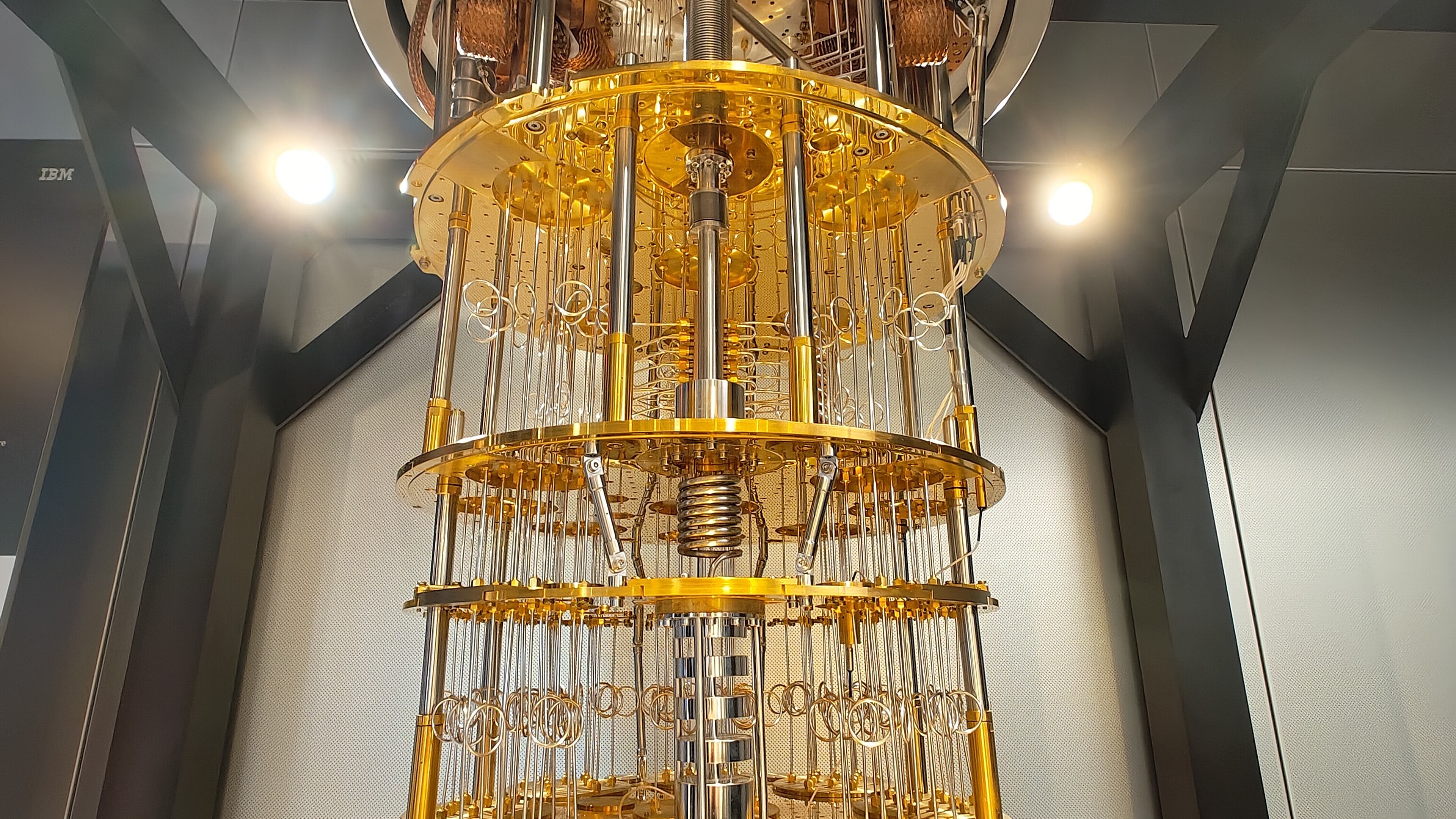
Cover photo: an IBM Quantum System One at IBM's TJ Watson Research Center — OJB Quantum / Wikimedia Commons, CC BY 4.0 (cropped; license: https://creativecommons.org/licenses/by/4.0).