The claim
OpenAI said on Nov 24 that its GPT-6 family of models has "intrinsic capabilities" for designing new proteins: in a preprint titled "GPT-6 as a Universal Foundation Model for Protein Biology: Beyond Specialized Models," the company reports that its models can design protein structures and sequences using only reasoning and general-purpose coding tools, without calling specialized biology models to generate the designs.
The preprint is the first of OpenAI's protein results to clear a wet lab. With research partner Onava, proteins built from a pre-released GPT-6.2's designs showed evidence of binding across five targets — cancer- and immune-relevant proteins including VEGF-A, PD-L1 and IL-17A. Specialized models were not out of the loop: SolubleMPNN supplied amino acid sequences for the designed shapes, and other protein models helped select which candidates to make and test.
Experiment one: shapes from the model
GPT-6.2 was given the three-dimensional structures of five target proteins, with the binding site marked, and wrote code to create three-dimensional designs for small proteins called minibinders — without using specialized protein AI models. Onava tested 322 minibinders in the lab; 35 (10.9%) tested positive for binding to their intended target: 18 for IL-17A, 8 for VEGF-A, 5 for PD-L1, 3 for IL-7Rα and 1 for TrkA. At least one candidate bound to each of the five targets.
OpenAI is candid about the comparison work: computationally, GPT-6.2's three-dimensional designs scored slightly lower than RFdiffusion, the specialized protein-design model, while its latest internal models scored higher. It also notes the original RFdiffusion study reported higher hit rates — but that rates depend heavily on how strictly researchers filter designs and how they define binding.
Experiment two: sequences from the model
The second experiment reversed the task: researchers supplied shapes of known binders and withheld the amino acid sequences, asking GPT-6.2 to propose new ones. In initial screens, 75 of 88 designs for MDM2 showed binding (85%), as did 26 of 42 for VEGF-A (62%) and 8 of 59 for PD-1 (14%). For three unpublished shapes GPT-6.2 itself had designed earlier, 14 of 107 new sequences (13.1%) produced proteins that screened positive. Two binders for the same PD-L1 structure differed from the original sequence at 52 and 58 of their 90 positions — which OpenAI cites as evidence the model is doing more than reproducing memorised sequences.
AI-assisted analysis
Machine-synthesised- Fact
OpenAI said on Nov 24 that its GPT-6 family of models can design new protein structures and sequences using only reasoning and general-purpose code, without calling specialized biology models to generate the designs, as detailed in its preprint 'GPT-6 as a Universal Foundation Model for Protein Biology: Beyond Specialized Models'.
Source: OpenAI(opens in a new tab) - Fact
With research partner Onava, proteins based on a pre-released GPT-6.2's designs showed evidence of binding across five targets, with specialized models (including SolubleMPNN) supplying amino acid sequences and helping select candidates for lab testing.
Source: OpenAI(opens in a new tab) - Figure
Of 322 minibinders tested in the lab against five targets, 35 (10.9%) tested positive for binding to their intended target: 18 for IL-17A, 8 for VEGF-A, 5 for PD-L1, 3 for IL-7Rα and 1 for TrkA.
Source: OpenAI(opens in a new tab) - Figure
In sequence-redesign tests, initial screens showed binding for 75 of 88 MDM2 designs (85%), 26 of 42 VEGF-A designs (62%) and 8 of 59 PD-1 designs (14%); for three unpublished GPT-6.2-designed shapes, 14 of 107 new sequences (13.1%) screened positive.
Source: OpenAI(opens in a new tab)
Synthesised by PulseGrid's editorial AI from the sourced claims in this article and reviewed by PulseGrid AI Desk. How we use AI.
Partner content · paid placement
Sponsored tile inventory: Q1 2027
Native tiles in the in-feed carousel and the article block, sold only with the visible Sponsored / Partner Content label. Slot sizes, positions and advertiser terms are published on the advertise page. No newsroom byline is ever attached to partner copy.
Antibody redesign also held. GPT-6.2 redesigned the binding loops of six small antibodies (VHHs) targeting IL-4Rα: 128 of 182 designs (70%) showed binding. Asked to change about half the amino acids in three binding loops of five therapeutic antibodies while keeping the rest intact, 179 of 272 tested fragments (66%) bound the original targets, PD-1 or PD-L1.
What it can't do — and what binding isn't
Predicting a complete protein's shape from its sequence remains the clear weakness. On experimentally measured structures, GPT-6.2 averaged 0.26 on the TM-score scale (1.0 is a perfect match) versus 0.93 for ESMFold2, a specialized folding model; OpenAI's latest internal model averaged 0.38. The company used ESMFold2 and other structure predictors to filter candidates before lab testing.
Binding is also only a first step, as OpenAI itself stresses: further work would be needed to establish specificity, stability and biological activity, along with safety and efficacy for therapeutic applications. No AI-developed drug has yet passed all clinical-trial phases. Chosun Ilbo's English edition, in a Nov 27 survey of the field, notes that a single drug typically takes 12–15 years and around $2.6 billion to develop, that the most advanced AI-designed candidate — Insilico Medicine's fibrosis treatment Rentorsetip — entered Phase 3 trials in July, and that DeepMind subsidiary Isomorphic Labs has yet to advance any candidate to the clinic. These are design candidates, not medicines.
What to watch
Function after binding. OpenAI's next tests are whether designed molecules produce a specific biological effect — such as killing a cancer cell — bind selectively, and are practical to manufacture.
Harder targets and wider molecules. OpenAI wants minibinders for targets where attempts have fallen short, and to extend the work to multi-target molecules, RNA, and small molecules including PROTAC degraders.
The specialist's role. Specialized models supplied sequences and candidate selection in both lab experiments; the emerging division of labour is a generalist model proposing designs and specialist tools validating them — with biosecurity risk assessed under OpenAI's Preparedness Framework.
Bottom line
The honest headline is narrower than "AI designs drugs" but still notable: a general-purpose model, prompted in plain language, produced protein designs that survived physical tests often enough to matter — and its sequence proposals diverge sharply from originals, which is what genuine design looks like. The gap on full-structure prediction and the absence of any functional, selective or safety testing keep this firmly in research-prototype territory. The near-term significance is workflow: as OpenAI's Joy Zhao put it, a future where scientists describe their goals in words and the model does the designing is getting closer.
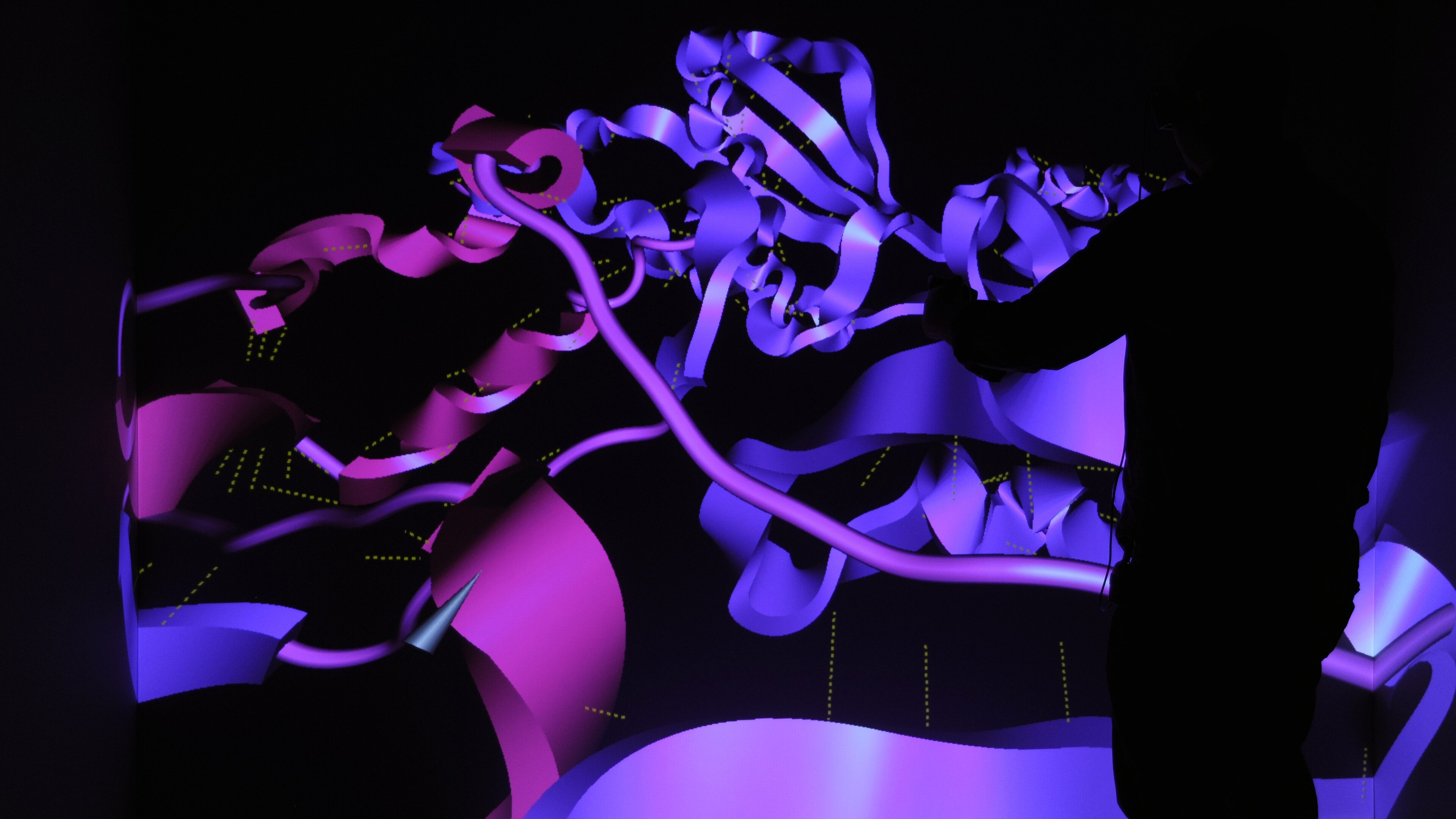
Cover photo: researchers examine 3D protein models in Idaho National Laboratory's CAVE visualization facility — Idaho National Laboratory / Wikimedia Commons, CC BY 2.0 (cropped; license: https://creativecommons.org/licenses/by/2.0).