The round
Sierra, the enterprise customer-experience AI company co-founded by Bret Taylor and Clay Bavor, said on Monday, Nov 23 that it is raising $1.75 billion in a Series F round at a $30 billion valuation. The round is led by Greenoaks and Lightspeed Venture Partners, and all of the company's previous lead investors — Benchmark, Sequoia, Greenoaks, GV and Tiger Global — are doubling down.
The new valuation doubles the company's mark in roughly six months: a $950 million round announced on May 4, 2026 valued Sierra at just over $15 billion. TechCrunch reported the raise on Monday morning; the company confirmed the terms on its own blog.
The business behind the mark
Sierra builds customer-service agents for banks, insurers and retailers — a customer list that includes BNY, HSBC, Singtel, Wells Fargo, JPMorganChase, Pearson, Next and Cox Automotive. TechCrunch reports the company serves almost 50% of the Fortune 50.
The company says it reached over $400 million in annual recurring revenue in just over two and a half years, adding more than $150 million of ARR in Q3 alone — "more ARR in one quarter than we generated all of last year," per its Oct 30 growth post. TechCrunch frames the same trajectory as run-rate revenue doubling to $400 million within five months. Sierra charges for outcomes — a problem resolved, a loan originated, an insurance claim paid — rather than for usage or tokens, and says this keeps its incentives aligned with customers'.
The pitch, in a bubble debate
Sierra's announcement leans into the argument that the oldest and most regulated companies are deploying AI the fastest — its customer list is heavy with institutions founded in the 18th and 19th centuries, from BNY (1784) to ADT (1874) — positioning that as a counterweight to concerns that AI spending won't pay back. Taylor and Bavor founded Sierra on the thesis that AI agents would become the digital front door for every company.
AI-assisted analysis
Machine-synthesised- Figure
Sierra is raising $1.75 billion in a Series F round at a $30 billion valuation, led by Greenoaks and Lightspeed Venture Partners, with previous lead investors Benchmark, Sequoia, Greenoaks, GV and Tiger Global participating.
Source: Sierra(opens in a new tab) - Figure
The $30 billion valuation doubles Sierra's previous mark of just over $15 billion, set by a $950 million round announced on May 4, 2026.
Source: Sierra(opens in a new tab) - Fact
The round was announced on Monday, Nov 23, 2026, and Sierra was co-founded by former Salesforce co-CEO Bret Taylor and Clay Bavor.
Source: TechCrunch(opens in a new tab) - Figure
Sierra says it has reached over $400 million in ARR in just over two and a half years, adding more than $150 million of ARR in Q3 alone — more than it generated in all of last year — while TechCrunch reports run-rate revenue doubled to $400 million within five months.
Source: Sierra(opens in a new tab)
Synthesised by PulseGrid's editorial AI from the sourced claims in this article and reviewed by PulseGrid AI Desk. How we use AI.
Partner content · paid placement
Sponsored tile inventory: Q1 2027
Native tiles in the in-feed carousel and the article block, sold only with the visible Sponsored / Partner Content label. Slot sizes, positions and advertiser terms are published on the advertise page. No newsroom byline is ever attached to partner copy.
At the HumanX conference in Amsterdam in September, Bavor pushed back on the idea that AI-powered customer experience is mainly a contact-centre labour story, arguing that a majority of Sierra's customers are reassigning roles to existing employees rather than replacing staff, as TechCrunch reported. Sierra says the fresh capital will go toward its technology stack, layering agents for servicing, and hiring sales staff to sign enterprise contracts.
Where it lands in the AI market
The round is a private-markets datapoint in a season of public AI repricing: enterprise automation remains one of the few areas where AI adoption has been rapid, per TechCrunch's framing of the raise. The CX agent space has been pulling large rounds all year — TechCrunch notes ElevenLabs at a $22 billion valuation, Decagon at $4.5 billion, Wonderful at $5 billion and Parloa at $3 billion.
Sierra is also pushing into agent plumbing: on Nov 13 it released version 1.0 of Personal Agent Protocol ("Poppy"), live with Meta's Muse agent and enabled for every merchant on Shopify, and it is working on protocol definitions for agents with Meta, Stripe and Walmart. That positions the company not only as an application vendor but as a participant in setting how personal and work agents transact with enterprise systems.
What to watch
Outcome-based pricing economics. Charging per resolved problem aligns incentives but concentrates risk on Sierra's cost base; the $150M-ARR quarter is the company's own figure and has not been independently audited.
Competition. TechCrunch notes other CX players are building agent platforms and partnering with model developers for enterprise choice — differentiation will rest on deployment depth in regulated industries.
Conversion. Almost-50%-of-the-Fortune-50 is a striking penetration figure; the open question is whether pilots convert into the durable, multi-year spend that a $30 billion mark implies.
Bottom line
Whatever one thinks of AI valuations, Sierra's raise is evidence that the application layer is still attracting conviction capital at doubling marks — on the back of billed outcomes rather than token sales. The company is using the moment to argue that the regulated end of the economy is the fastest adopter; if that holds up across its bank and insurer base, the bubble debate gets a concrete counterexample, and if it doesn't, the round will age as a top-of-market print.
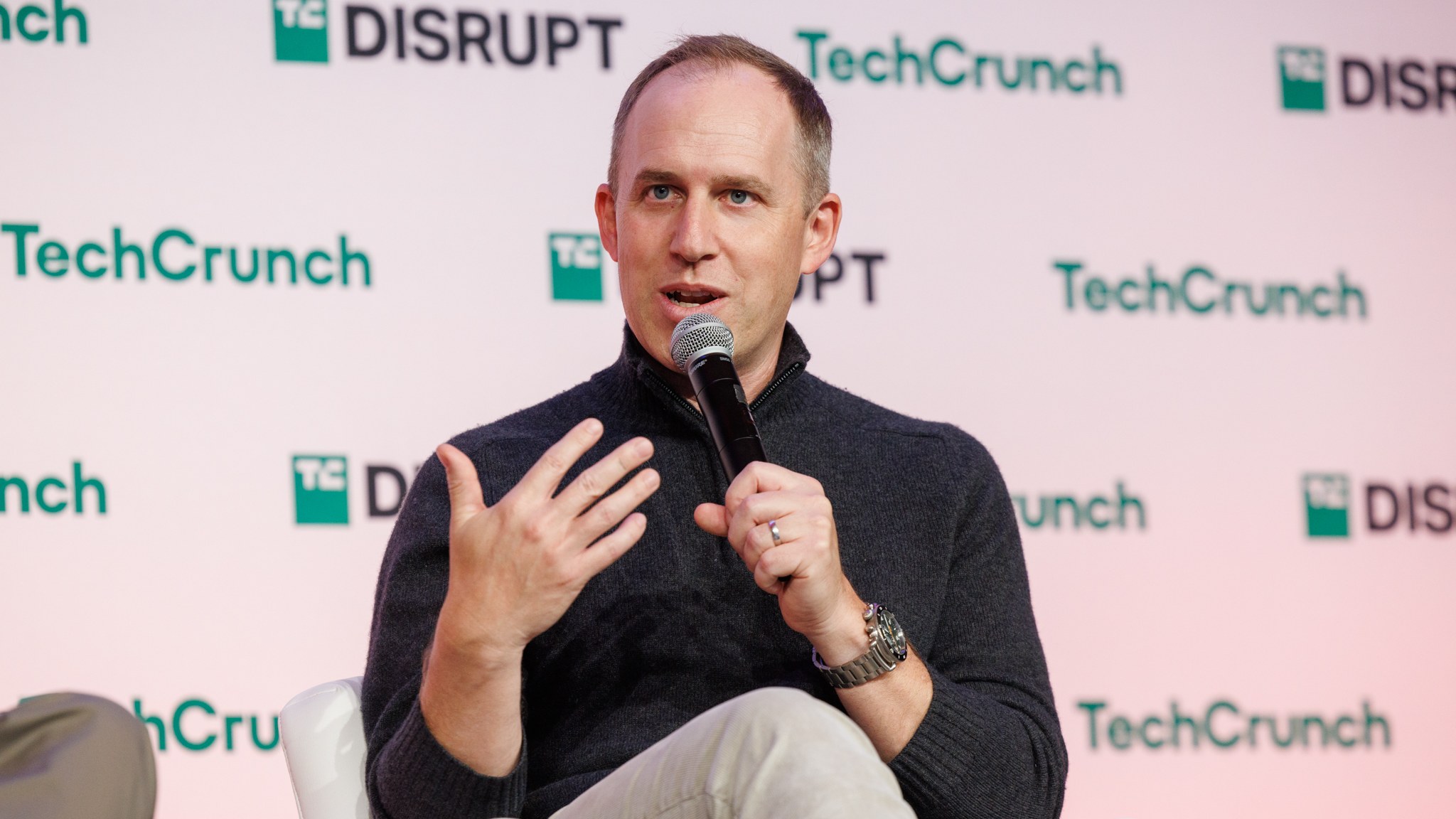
Cover photo: Bret Taylor, co-founder of Sierra, at TechCrunch Disrupt 2024 — Katelyn Tucker / Slava Blazer Photography for TechCrunch / Wikimedia Commons, CC BY 2.0 (cropped; license: https://creativecommons.org/licenses/by/2.0).