The Hague draws a line: “not simply be told what to do”
The Netherlands will ask Washington not to enforce proposed export restrictions that would harm ASML and other European technology companies if the US MATCH Act becomes law, Dutch trade minister Sjoerd Sjoerdsma told parliament on Thursday. “We will not simply be told what to do. If the act is adopted, our message to the US administration will be to not enforce it,” Sjoerdsma said during a parliamentary debate — the first time a named EU government has publicly adopted a non-enforcement position toward the bill.
The statement escalates a standoff that had, until this week, played out in diplomatic channels. The Netherlands has previously aligned with US-led export controls aimed at slowing China’s ability to make its own chips — measures that hit ASML’s export business — but has opposed the MATCH Act on sovereignty grounds.
What the MATCH Act would do
The bipartisan Multilateral Alignment of Technology Controls on Hardware, or MATCH Act, is being negotiated in Congress for adoption next month as part of the annual US defence spending bill. The legislation would force allies including the Netherlands and Japan to adopt tougher export controls on advanced chipmaking equipment — including ASML’s immersion deep-ultraviolet (DUV) lithography tools — or face unilateral US restrictions on their equipment.
ASML, Europe’s most valuable listed company, expects China to account for about 20% of this year’s sales. The company declined to comment on Thursday, but CEO Christophe Fouquet warned last week that the proposed US curbs would likely accelerate China’s development of rival technology. Sjoerdsma said the bill would hurt not only ASML but the technology sectors of other European nations as well. In a separate account of the same debate, the minister cast US policy in blunt terms: “The US is not the boss of Veldhoven … they would really like to have that within their own borders. But they don’t,” adding that Washington has “a certain amount of jealousy of the capacities that the Netherlands and ASML have here.”
A coalition to block the bill — and a Beijing overture
Sjoerdsma said he is working with the European Commission, Germany and France to prevent the MATCH Act’s passage, and that the Netherlands and the EU would explore bilateral and European measures to limit its consequences — including whether counter-measures were needed.
AI-assisted analysis
Machine-synthesised- Quote
Dutch trade minister Sjoerd Sjoerdsma told parliament on Thursday that if the MATCH Act is adopted, the Netherlands will ask the US administration not to enforce it, saying: “We will not simply be told what to do. If the act is adopted, our message to the US administration will be to not enforce it.”
Source: Reuters (via Yahoo Finance)(opens in a new tab) - Fact
The MATCH Act — the bipartisan Multilateral Alignment of Technology Controls on Hardware — is being negotiated in Congress for adoption next month as part of the annual US defence spending bill, and would force allies including the Netherlands and Japan to adopt tougher export controls or face unilateral US restrictions on their equipment, including ASML’s immersion DUV lithography tools.
Source: Reuters (via Yahoo Finance)(opens in a new tab) - Fact
The Netherlands has previously aligned with US-led export controls aimed at slowing China’s ability to make its own chips, measures that impacted ASML’s export business, but has opposed the MATCH Act on sovereignty grounds.
Source: Reuters (via Yahoo Finance)(opens in a new tab) - Figure
ASML, Europe’s most valuable listed company, expects China to account for about 20% of this year’s sales, and CEO Christophe Fouquet warned last week that the proposed US curbs would likely accelerate China’s development of rival technology.
Source: Reuters (via Yahoo Finance)(opens in a new tab)
Synthesised by PulseGrid's editorial AI from the sourced claims in this article and reviewed by PulseGrid AI Desk. How we use AI.
Partner content · paid placement
Sponsored tile inventory: Q1 2027
Native tiles in the in-feed carousel and the article block, sold only with the visible Sponsored / Partner Content label. Slot sizes, positions and advertiser terms are published on the advertise page. No newsroom byline is ever attached to partner copy.
His remarks followed a visit to Beijing by Dutch foreign minister Tom Berendsen on Wednesday, during which China and the Netherlands said they were committed to bilateral talks on export controls. China has previously condemned the MATCH Act and warned of countermeasures.
Analysts are already gaming out the response. Sanne van der Lugt, director of the China programme at the Global Trade Policy Observatory, said that if the MATCH Act is enacted, the EU should consider using its Blocking Statute — the instrument that bars European companies from complying with certain foreign rules — but warned that Europe would need to expect retaliation from Washington. “Completely disregarding the MATCH Act is only realistic if Europe is prepared to engage in a large-scale trade conflict with the US,” Van der Lugt said.
Bottom line
Export controls only work through the allied toolmakers that build the chokepoint equipment — and for DUV lithography, that means Veldhoven. The Dutch non-enforcement ask, backed by a nascent Brussels-Berlin-Paris blocking coalition, turns the MATCH Act from a Washington drafting exercise into a transatlantic enforcement question: even if Congress attaches the bill to next month’s defence spending package, the machinery of implementation now runs through governments that say they will not help operate it. For buyers of advanced chipmaking capacity — including data-centre and AI-infrastructure developers in Africa and Asia watching the licence geography closely — the practical rule set is getting harder to read, not easier.
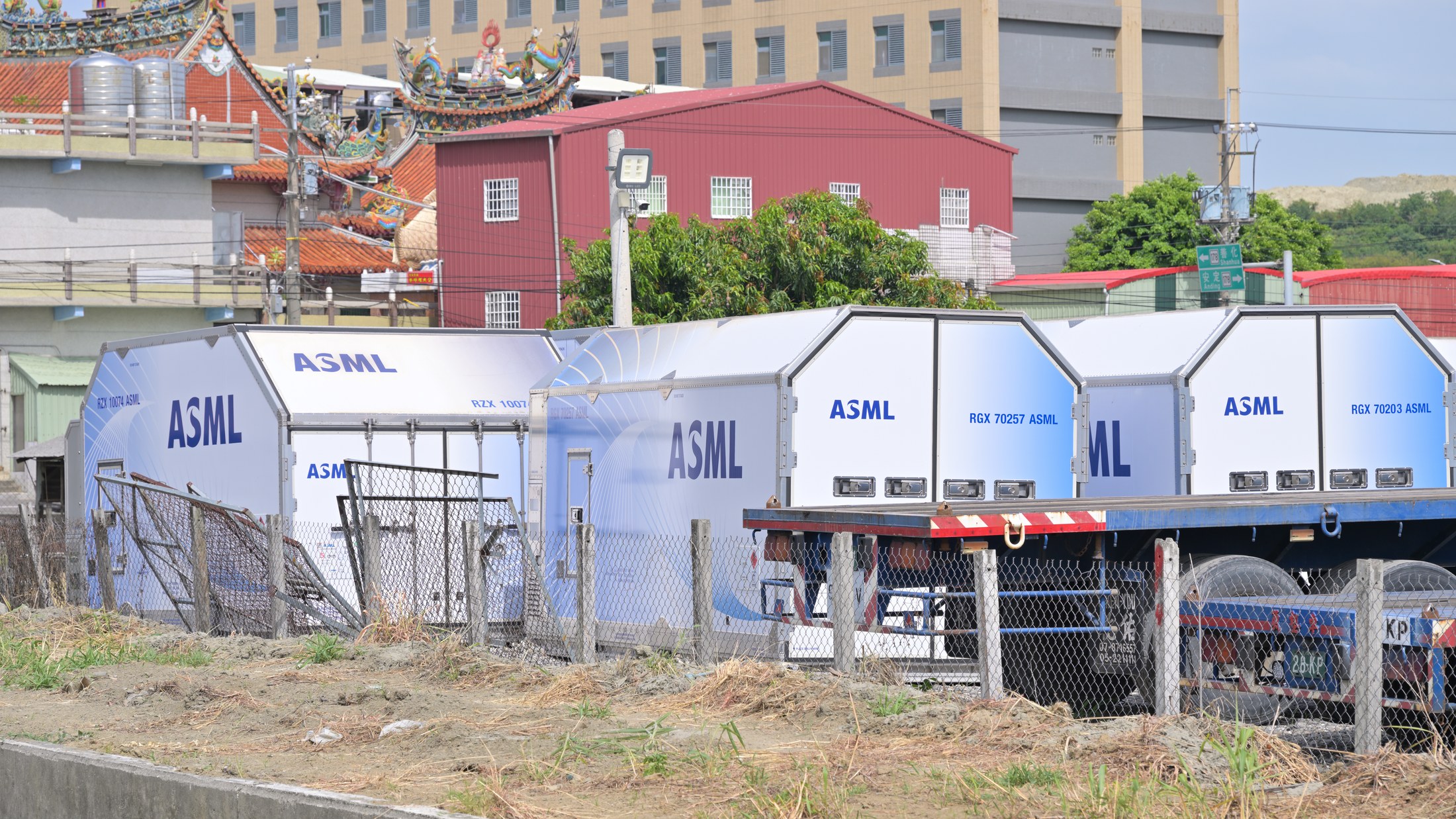
Cover photo: ASML air freight containers in Tainan, May 2025 — 4300streetcar / Wikimedia Commons, licensed CC BY 4.0 (cropped; license: https://creativecommons.org/licenses/by/4.0).