The move
MTN Group is seeking a regional banking licence in Nigeria and financial services licences in Ghana and Rwanda, group CEO Ralph Mupita disclosed to Semafor in an interview at the outlet's Next Three Billion summit in Johannesburg. The company expects the approvals “in the next year or two” — its own estimate, not a commitment from any regulator.
The goal is to move MTN's mobile money business beyond basic transfers into higher-value financial products: lending, savings and remittances. Mupita argued that services such as peer-to-peer transfers and cash-in, cash-out will increasingly become commonplace, pushing MTN toward products that earn more.
What MTN has — and what it wants
The base is already large. Mupita said the fintech platform has 70 million active users and processed transactions worth more than $500 billion in the nine months to the end of September. In Nigeria, its biggest market, MTN already runs MoMo Payment Service Bank (PSB) under a licence from the Central Bank of Nigeria, offering loans today through partnerships with banks and other financial institutions. In August, Mupita said MTN was exploring banking licences that would let it take deposits and gradually lend from its own balance sheet — a move he said would be gradual because balance-sheet lending adds risk.
Ghana was already in motion: MTN Ghana was reported in March to be in active talks with the Bank of Ghana over a digital banking licence, and its MoMo platform there serves more than 19 million active users. Rwanda is the third target market. It is not clear whether MTN has filed formal applications with the central banks in all three countries, and the one-to-two-year timeline is the company's own estimate.
Why it matters
Mobile money has been a major business for Africa's telecom operators since Safaricom launched M-Pesa in Kenya in 2007, and the largest players are now converting payment networks into full financial-services businesses — territory traditionally occupied by banks. Airtel Money, the financial services business controlled by Airtel Africa, was valued at about $7 billion when it listed in London last month. MTN's applications, if granted, would put a 70-million-user distribution network into direct competition with commercial banks and established fintechs in lending and deposits.
AI-assisted analysis
Machine-synthesised- Fact
MTN Group is seeking a regional banking licence in Nigeria and financial services licences in Ghana and Rwanda, CEO Ralph Mupita told Semafor at its Next Three Billion summit in Johannesburg, expecting approvals “in the next year or two” — the company's own estimate, with no regulator commitment.
Source: Techpoint Africa(opens in a new tab) - Figure
MTN's fintech platform has 70 million active users and processed transactions worth more than $500 billion in the nine months through the end of September 2026, according to Mupita.
Source: Semafor (via Yahoo Finance)(opens in a new tab) - Fact
In Nigeria, MTN runs MoMo Payment Service Bank under a CBN licence and currently offers loans through partnerships with banks and other financial institutions; in August, Mupita said MTN was exploring banking licences that would let it take deposits and gradually lend from its own balance sheet.
Source: Techpoint Africa(opens in a new tab) - Fact
In Ghana, MTN Ghana was reported in March to be in active talks with the Bank of Ghana over a digital banking licence, and its MoMo platform there serves more than 19 million active users.
Source: Techpoint Africa(opens in a new tab)
Synthesised by PulseGrid's editorial AI from the sourced claims in this article and reviewed by PulseGrid AI Desk. How we use AI.
Partner content · paid placement
Sponsored tile inventory: Q1 2027
Native tiles in the in-feed carousel and the article block, sold only with the visible Sponsored / Partner Content label. Slot sizes, positions and advertiser terms are published on the advertise page. No newsroom byline is ever attached to partner copy.
Mupita said MTN plans to grow the business mainly on its own: “we're not looking at the conventional kind of M&A” for fintech, he said. The telecoms side of the group is a different story — MTN proposed a $6.2 billion buyout of IHS Towers in February and this month revived talks to buy Telkom, South Africa's former fixed-line monopoly. At the summit Mupita also argued South Africa's mobile market needs to coalesce around two or at most three operators, calling consolidation “inevitable, as has happened in Europe.”
What to watch
The applications themselves. MTN has disclosed intent and a timeline, but formal filings with the Central Bank of Nigeria, the Bank of Ghana and the National Bank of Rwanda have not been confirmed — and the approvals belong to regulators in Abuja, Accra and Kigali.
The deposit question. The strategic shift is from partnership-based lending to taking deposits and lending from MTN's own balance sheet — a different risk profile that supervisors will scrutinise, and a step beyond the payment-service-bank perimeter MTN operates under in Nigeria today.
The competitive response. With Airtel Money now publicly valued and OPay, Moniepoint and others building credit books off Nigerian payment rails, the licence race decides who gets to intermediate Africa's mobile-money savings.
Bottom line
This is the flagship applicant for the telecom-to-banking transition African fintech has been waiting on: the continent's largest mobile operator putting a 70-million-user platform that moved more than $500 billion in nine months on a path to deposits and credit. Nothing is approved yet — the timeline is MTN's own, and three central banks still have to agree — but the direction of travel is now on the record from the group CEO himself.
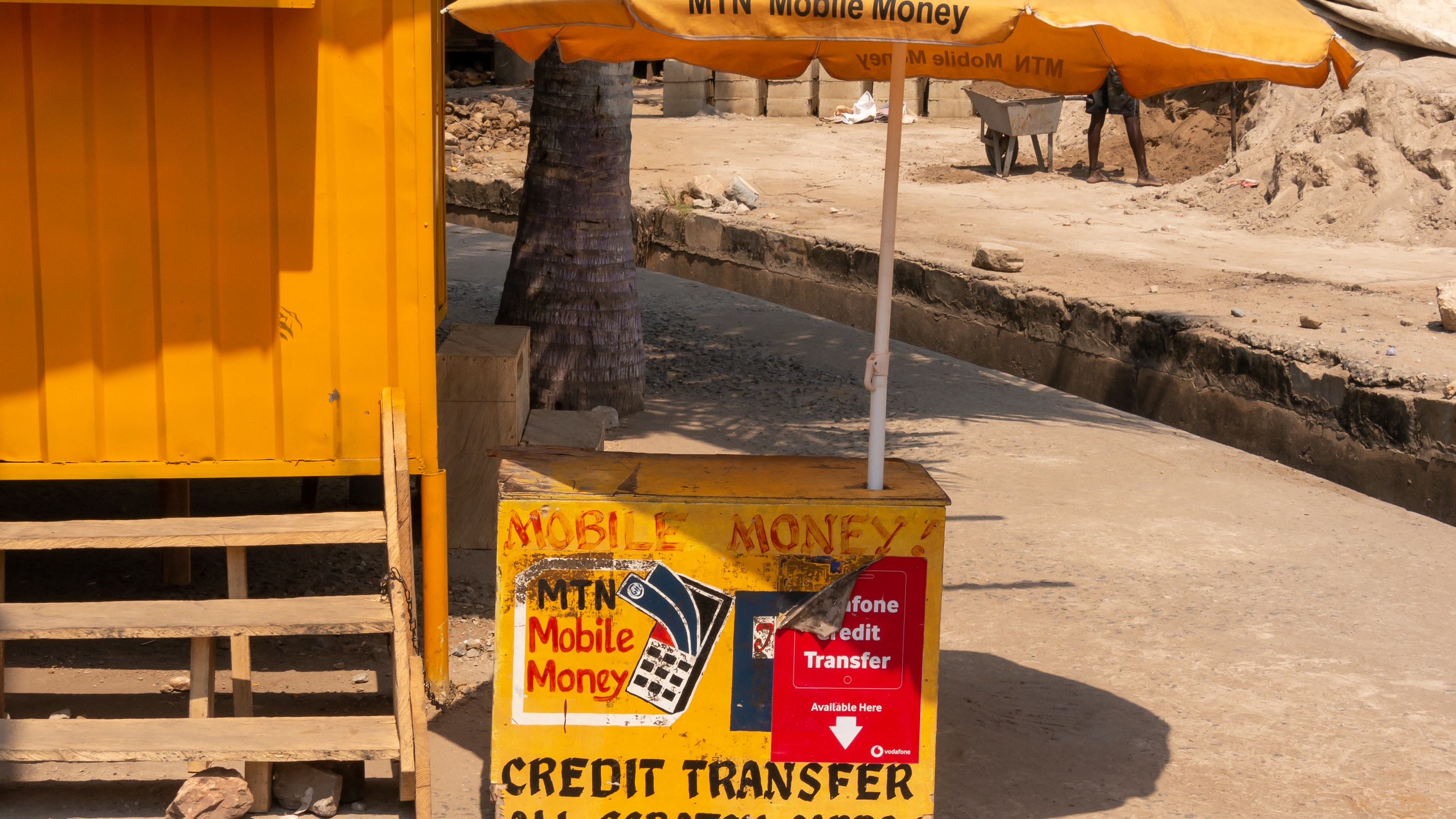
Cover photo: MTN MoMo stand, Korle-Klottey — Matti Blume / Wikimedia Commons, licensed CC BY-SA 4.0 (cropped; license: https://creativecommons.org/licenses/by-sa/4.0).