The announcement
SK Hynix said on Monday it plans to spend 1.4 trillion won (about $1.05 billion) over the next five years to support domestic suppliers of semiconductor materials, parts and equipment, framing the programme as a way to strengthen its supply chain as competition intensifies in the AI-chip market.
The centrepiece is Trinity Fab, a jointly funded testing facility with a total investment of 874.6 billion won by SK Hynix, the central government and local governments, built inside the company's Yongin complex south of Seoul. Under the funding split reported by Reuters, SK Hynix contributes 443.2 billion won, the central government 373.6 billion won and local governments 57.7 billion won.
The facility's clean room is scheduled to open in May 2027, with equipment installation and evaluation services to begin in the fourth quarter of that year.
What Trinity Fab actually is
The problem it addresses is a specific bottleneck in chip manufacturing: materials and equipment cannot be deployed to factories until they have been tested on production lines alongside other equipment, but small suppliers struggle to secure mass-production-grade clean rooms and tools on their own, and borrowing a chipmaker's lines is hard because product manufacturing takes priority.
Trinity Fab sits adjacent to SK Hynix's memory mass-production lines and shares the same environment and infrastructure — power, water and gas supply, wastewater treatment. It will gradually install 51 pieces of equipment, including 300mm wafer-based process, measurement and inspection tools used in semiconductor mass production, plus 15 independent rental spaces of 13.5 pyeong each where companies can bring their own equipment. Professional staff for equipment operation, maintenance and analysis are part of the package.
AI-assisted analysis
Machine-synthesised- Figure
SK Hynix said on Monday it plans to spend 1.4 trillion won ($1.05 billion) over the next five years to support domestic suppliers of semiconductor materials, parts and equipment, aiming to strengthen its supply chain as competition intensifies in the AI chip market.
Source: Reuters(opens in a new tab) - Figure
Trinity Fab, a testing facility for materials, parts and equipment companies, is being built inside SK Hynix's Yongin complex with a total investment of 874.6 billion won by SK Hynix, the central government and local governments.
Source: The Chosun Ilbo (English)(opens in a new tab) - Figure
In the Trinity Fab funding split, SK Hynix contributes 443.2 billion won, the central government 373.6 billion won and local governments 57.7 billion won.
Source: Reuters(opens in a new tab) - Fact
Trinity Fab is scheduled to open its clean room in May 2027, install equipment and begin evaluation services in the fourth quarter of 2027.
Source: The Chosun Ilbo (English)(opens in a new tab)
Synthesised by PulseGrid's editorial AI from the sourced claims in this article and reviewed by PulseGrid AI Desk. How we use AI.
Partner content · paid placement
Sponsored tile inventory: Q1 2027
Native tiles in the in-feed carousel and the article block, sold only with the visible Sponsored / Partner Content label. Slot sizes, positions and advertiser terms are published on the advertise page. No newsroom byline is ever attached to partner copy.
Lee Ki-jeong, who represents the Trinity Fab Foundation, said data from the facility has a very high likelihood of being replicated in actual mass-production lines. The foundation aims to cut the commercialisation period for materials, parts and equipment products by more than 30%; Lee Jae-ho, vice chairman of equipment company TES, said the five-to-six-year cycle from equipment development to mass-production application could be shortened by about a year.
Money beyond the testbed
The five-year, 1.4 trillion won programme is described as mutual-growth funding. A newly established R&D Challenge Reward System, launched in 2026, provides partners up to 50% of development costs upfront when they develop technologies SK Hynix needs — and, notably, rewards are evaluated on achievements and contributions even if development fails or does not lead to purchases, a design meant to reduce the financial fear that keeps small suppliers away from hard R&D.
For production financing, SK Hynix is backing an Export Supply Chain Strengthening Guarantee — together with commercial banks and the Korea Trade Insurance Corporation — that plans roughly 2 trillion won in financial support over five years, including expanded loan limits and reduced interest rates for first-, second- and third-tier partners.
The physical clustering matters too. A materials, parts and equipment partnership complex is planned within a two-minute walk of the Y1 fab, with more than 50 domestic and international companies — including ASML, Lam Research and Jusung Engineering — scheduled to move in.
Why a memory maker is co-funding factories-for-its-vendors
The Yongin Semiconductor Cluster is billed as the world's largest semiconductor production hub: four fabs on a 4.15 million square-metre site, with Y1's first clean room scheduled for February 2027 and about 20,000 people mobilised daily on site. Building the fabs is only half the job; the ecosystem that services them needs its own capacity.
That is the strategic read. In the HBM era, a memory maker's output is capped by its suppliers' ability to qualify new materials and tools quickly. Financing that qualification — and sharing the risk of failure — converts a procurement relationship into an industrial policy, with the state co-signing. The same pattern is now visible across the AI-chip stack: bottleneck segments are being funded by their own customers.
Lee Hyun-cheol, SK Hynix's vice president and head of procurement strategy, put it in ecosystem terms: the capabilities of its partners are SK Hynix's competitiveness, and ultimately the competitiveness of the entire semiconductor ecosystem, and the company will share process know-how, assets, funds and talent-development capabilities to collectively grow the Korean semiconductor industry.
What to watch
The Trinity Fab clean-room opening in May 2027 is the first hard milestone; evaluation services in Q4 2027 will show whether small suppliers actually use it.
The 30%-faster-commercialisation target is the number to hold the foundation to. If it slips, the facility becomes a subsidy rather than a testbed.
And the supplier-financing stack — 1.4 trillion won in mutual-growth funds plus roughly 2 trillion won in guarantees — sets a benchmark for how much of the AI supply chain is now being underwritten by champions and states rather than by private capital alone.
Bottom line
This is not a capacity announcement; it is a capacity-enabler announcement. The AI-memory race is being won or lost in the qualification cycles of suppliers most people outside the industry cannot name, and SK Hynix has decided to pay for that layer itself, with the Korean state picking up a third of the flagship facility.
PulseGrid will track Trinity Fab's opening in May 2027 and whether the promised compression of supplier commercialisation timelines shows up in practice.
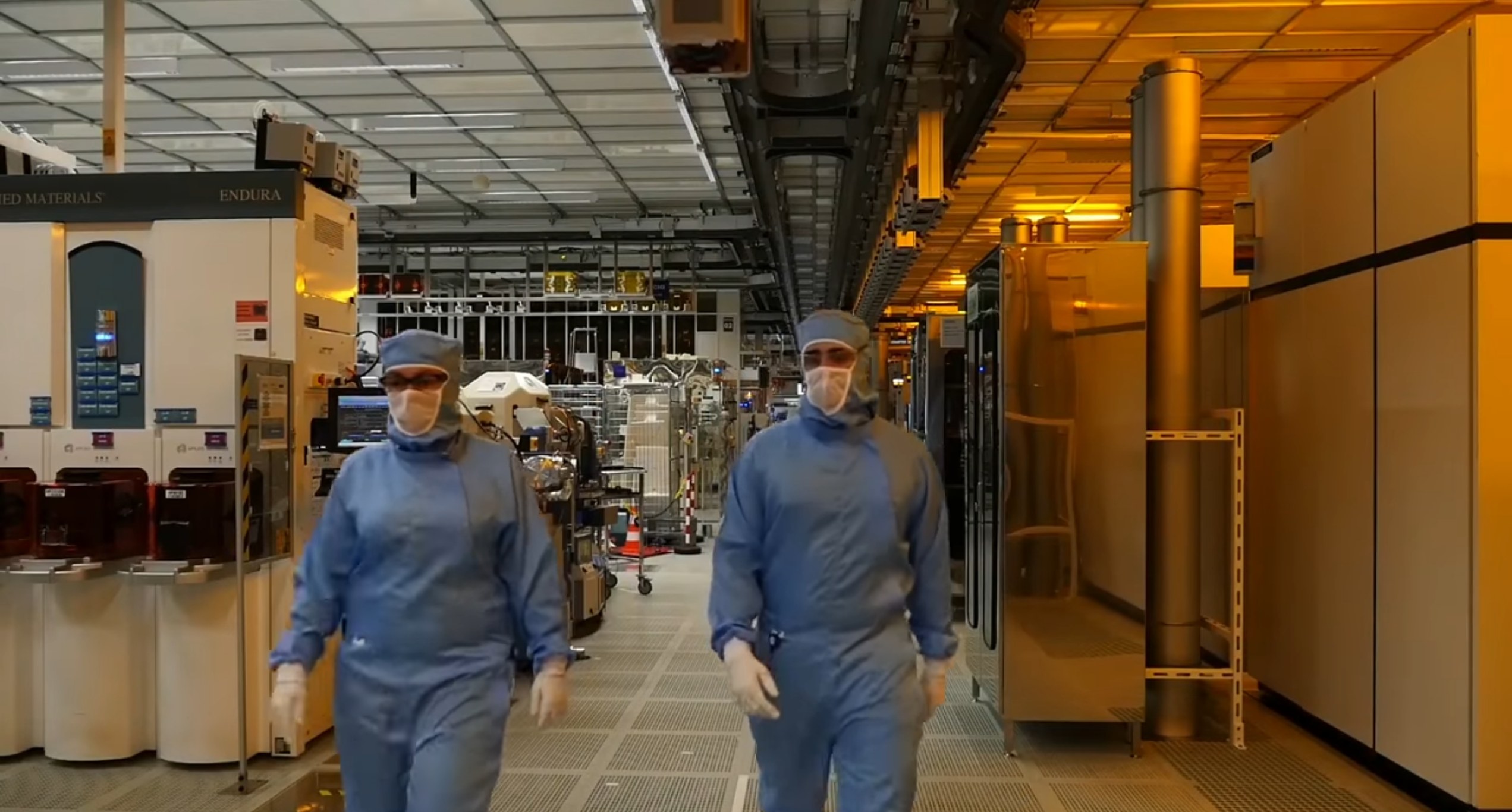
Cover photo: How ST designs and manufactures semiconductor devices - screenshot 1 — STMicroelectronics (original work) Una tantum (screenshot) / Wikimedia Commons, licensed CC BY 3.0 (cropped; license: https://creativecommons.org/licenses/by/3.0).