The squeeze
The AI data-center buildout has become a direct competitor to Boeing and the prime defense contractors for the physical inputs of industrial America. In an investigation published Nov 28, the Financial Times reports that AI data-center builders now bid against aerospace and defense for memory chips, skilled workers, land, power, printed circuit boards, castings, and the electrical switchgear and climate-control systems used to fit out new factories.
“Hyperscaling is sucking all the oxygen out of the room, whether it’s workforce, land, energy, and raising the costs on supplies,” Eric Fanning, chief executive of the Aerospace Industries Association, told the FT. His group represents US defense contractors and their suppliers — the tier of industry now absorbing the cost shift.
Memory is the sharpest pinch
The numbers behind the complaint are blunt. Boeing’s backlog of undelivered commercial aircraft stands at around 6,300 — an all-time high, the FT reports — while on the defense side the Pentagon has been pressing contractors to raise ammunition output following the Ukraine-Russia war and the conflict between the United States and Iran.
Memory is a specific choke point. Prices have skyrocketed as the big memory makers reallocate wafers toward high-bandwidth memory for AI accelerators, and capacity for the “outdated” chips used in aviation and defense has been pulled away. That is the semiconductor supercycle’s demand-destruction layer: the chips that fly planes and guide munitions are built on mature nodes that memory makers no longer prioritize, and aerospace qualification cycles mean those parts cannot be swapped quickly.
Industry leaders also told the paper that even aerospace and defense companies building big new plants are losing out to data-center developers for construction labor and factory kit — including steel, electrical switches and climate-control systems. The FT does not name specific Boeing or defense programs already slipping schedule because of the parts competition; its account leans on the industry association and a small number of executives.
AI-assisted analysis
Machine-synthesised- Fact
An FT investigation published Nov 28, 2026 finds AI data-center builders now compete directly with Boeing and the prime defense contractors for memory chips, skilled workers, land, power, printed circuit boards, castings, and electrical switchgear and climate-control systems.
Source: AI Weekly(opens in a new tab) - Quote
Aerospace Industries Association CEO Eric Fanning told the FT that hyperscaling is 'sucking all the oxygen out of the room, whether it's workforce, land, energy, and raising the costs on supplies.'
Source: AI Weekly(opens in a new tab) - Figure
Boeing's backlog of undelivered commercial aircraft stands at around 6,300, an all-time high; the Pentagon has been pressing contractors to raise ammunition output after the Ukraine-Russia war and the US-Iran conflict; memory makers reallocating wafers to high-bandwidth memory for AI have pulled capacity from the 'outdated' chips used in aviation and defense as prices skyrocketed.
Source: AI Weekly(opens in a new tab) - Fact
The FT does not name specific Boeing or defense programs already slipping schedule because of the parts competition; its account leans on the industry association and a small number of executives.
Source: AI Weekly(opens in a new tab)
Synthesised by PulseGrid's editorial AI from the sourced claims in this article and reviewed by PulseGrid AI Desk. How we use AI.
Partner content · paid placement
Sponsored tile inventory: Q1 2027
Native tiles in the in-feed carousel and the article block, sold only with the visible Sponsored / Partner Content label. Slot sizes, positions and advertiser terms are published on the advertise page. No newsroom byline is ever attached to partner copy.
Labor: the Abilene front
The labor front of the same war is visible in Abilene, Texas, where CNBC traveled to document the construction boom around the $500 billion Stargate project for OpenAI, Oracle and SoftBank. Across the country, tech companies are competing for a limited pool of electricians, plumbers and other skilled construction workers; Associated Builders and Contractors estimates the construction industry needs to attract 349,000 net new workers in 2026 just to keep pace with demand.
For Abilene homebuilder Gene Lantrip, the boom is “a two-edged sword” — new business and residents for the city, but a smaller, more expensive pool of workers to hire from. Master electrician Scotty Wristen said local commercial electrical companies have lost workers to data-center jobs paying far above scale: “I know of one company that lost 42 guys in one day,” he said. “If I was young and didn’t have a wife and kids, I would probably do it too, because they pay at least triple what I can pay.”
The tech giants are trying to grow the pool: Meta, Google and Amazon are spending millions on training programs that place aspiring builders at data-center sites, and ABC is partnering with Meta on its $115 million American Workforce Academy. But the structural question — whether construction labor can expand as fast as the buildout — remains open, and it caps how fast any GPU forecast can actually be delivered.
What it means
Power, transformers and land were already on the physical bottleneck list. Chips, skilled trades, switchgear, PCBs and castings now join it — and unlike capital, none of these scale with a financing round. The compute buildout is functioning as an industrial-policy tax on non-tech output at exactly the moment the Pentagon is pushing ammunition production up.
For African data-center and industrial planners the read-across is direct: the same equipment queues (transformers, switchgear, generators) and the same memory pricing run through Lagos and Nairobi builds, and local skills pipelines are thinner than Texas’s. When global buyers pay triple scale for electricians and prepay five years out for memory, emerging-market projects are last in both queues.
The unresolved question is distribution: who decides which industry gets the transformer, the wafer starts, or the electrician — the market’s highest bidder, or industrial policy? So far, the answer is the highest bidder.
Bottom line
“Sucking all the oxygen out of the room” is no longer a metaphor. The AI buildout’s true cost is what it displaces: a 6,300-plane backlog competing for the same memory as training clusters, and defense supply chains orphaned by a wafer mix optimized for accelerators. The crowding-out has a price tag now — and industries that cannot outbid hyperscalers are paying it.
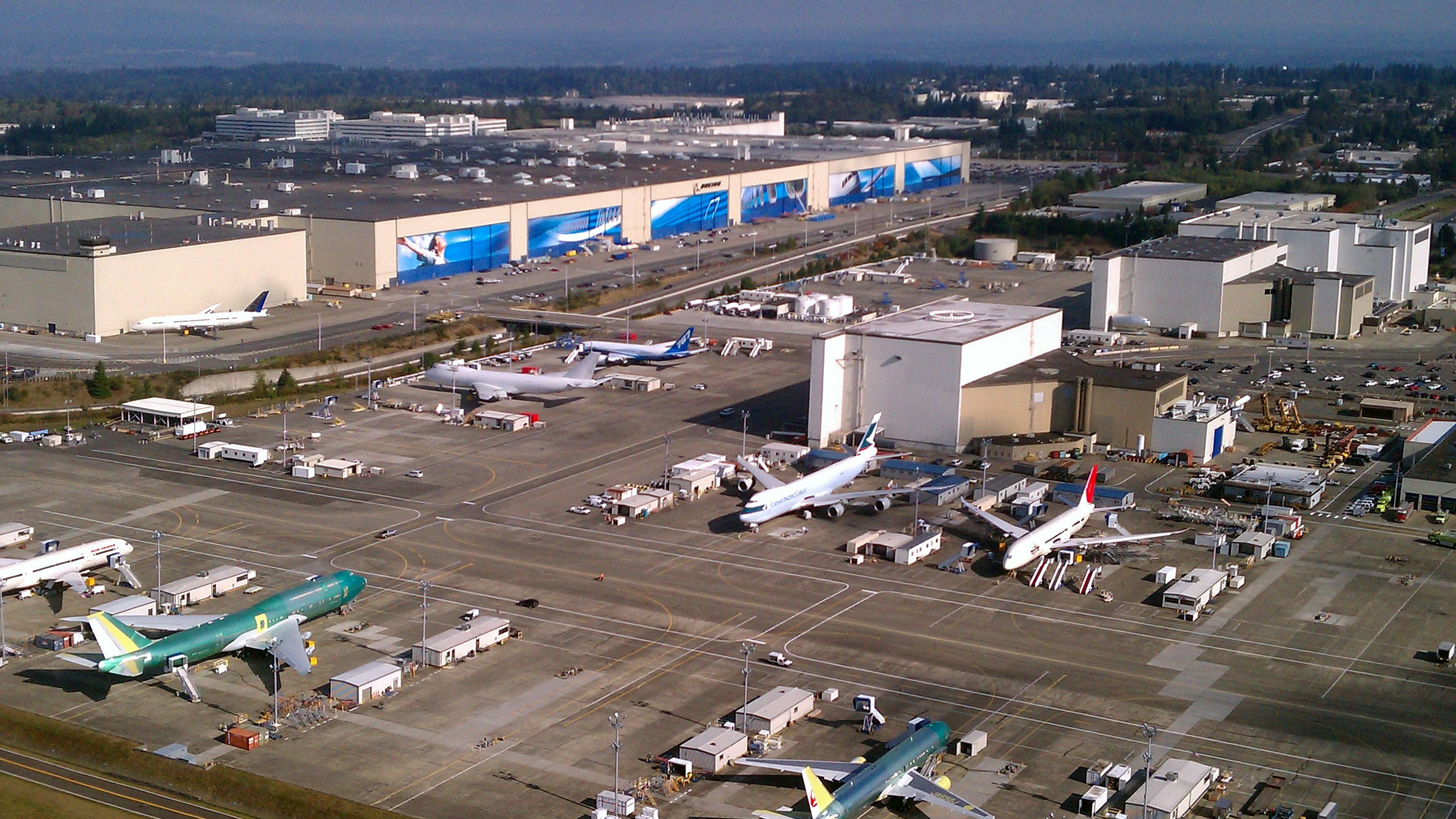
Cover photo: Boeing’s Everett Factory — Jeremy Elson / Wikimedia Commons, licensed CC BY-SA 3.0 (cropped; license: https://creativecommons.org/licenses/by-sa/3.0).