The sharp end
At a top private school in Beijing, 13-year-old Peng Gaodi has used artificial intelligence to build more than 200 apps, including a homework-submission platform and a secondhand marketplace. He pitches ideas to real investors, idolises Elon Musk and hopes to become a computer scientist. Around him, classmates program humanoid robots to play soccer, attend coding workshops and train on flight simulators; posters across the 30-acre boarding campus encourage students to "create a virtual world in five minutes with AI vibe coding."
Rare access granted to Reuters at the $39,000-a-year Beijing New Talent Academy offers a window into China's push to weave AI into education. The school, serving more than 2,000 students, has built its own digital innovation curriculum covering AI, robotics and programming, and developed a classroom AI model incorporating features from popular Chinese systems.
"In the past, if I couldn't solve a problem at home, I'd have to call my teacher, which increases their workload," Peng said. "But now I can just ask AI to help me learn better. It noticeably improved my learning efficiency."
Scale: almost 200 million students
The academy is the sharp end of a far broader transformation. With almost 200 million students enrolled in primary and secondary education, China is undertaking one of the world's largest AI-assisted learning experiments, with the technology increasingly integrated into teaching nationwide. By 2030, Beijing wants AI literacy to be universal among schoolchildren; current guidelines say students should progress from understanding basic concepts in their early years to applying advanced tools and critical-thinking skills in complex projects.
A weeks-long Reuters examination — based on school visits, interviews with more than a dozen educators, parents and experts, and a review of more than 100 academic papers and government procurement records — paints one of the most detailed pictures yet of how AI is reshaping Chinese classrooms. It found a sweeping but uneven effort to build a generation of AI-savvy innovators, with little consensus on what AI literacy means, how it should be taught or how it should be measured.
AI-assisted analysis
Machine-synthesised- Fact
At the $39,000-a-year Beijing New Talent Academy, 13-year-old Peng Gaodi has used AI to build more than 200 apps, and the school of more than 2,000 students has built its own curriculum covering AI, robotics and programming plus a classroom AI model incorporating features from popular Chinese systems.
Source: The Japan Times (Reuters)(opens in a new tab) - Quote
"In the past, if I couldn't solve a problem at home, I'd have to call my teacher, which increases their workload. But now I can just ask AI to help me learn better. It noticeably improved my learning efficiency."
Source: The Japan Times (Reuters)(opens in a new tab) - Figure
With almost 200 million students enrolled in primary and secondary education, China is undertaking one of the world's largest AI-assisted learning experiments, and by 2030 Beijing wants AI literacy to be universal among schoolchildren.
Source: Global Banking & Finance Review (Reuters)(opens in a new tab) - Fact
A weeks-long Reuters examination based on school visits, interviews with more than a dozen educators, parents and experts, and a review of more than 100 academic papers and government procurement records found a sweeping but uneven effort, with little consensus on what AI literacy means, how it should be taught or measured.
Source: Global Banking & Finance Review (Reuters)(opens in a new tab)
Synthesised by PulseGrid's editorial AI from the sourced claims in this article and reviewed by PulseGrid AI Desk. How we use AI.
Partner content · paid placement
Sponsored tile inventory: Q1 2027
Native tiles in the in-feed carousel and the article block, sold only with the visible Sponsored / Partner Content label. Slot sizes, positions and advertiser terms are published on the advertise page. No newsroom byline is ever attached to partner copy.
China views the technology as central to its economic future and its technological rivalry with the United States, hoping early exposure will nurture the homegrown innovation needed for major breakthroughs. President Xi Jinping has declared AI education fundamental to reform. By contrast, the United States relies on decentralised, nonbinding guidance and lacks dedicated funding or state-level teacher standards, according to Stanford University's 2026 AI Index.
Provincial blueprints, surveillance included
A Reuters review of provincial "AI+ education" blueprints reveals a degree of official coordination unseen elsewhere. Nearly half of China's provinces and municipalities have rolled out binding plans. Shanghai mandates at least 30 hours of annual teaching on AI skills per grade, while the Beijing city government plans to integrate AI into student health monitoring and set up 100 AI pilot demonstration schools. Regions including Ningxia and Gansu plan to integrate AI literacy directly into high-stakes school entrance exams by 2027.
The documents also offer a first look at more expansive classroom applications. Beyond coding and tutoring, Guizhou is integrating AI facial recognition and behavioural analysis into classrooms, Shanghai is deploying systems for mental and physical health monitoring, and in Yunnan 14,000 classrooms are slated to have lessons recorded and analysed by AI — turning Chinese schools into a high-stakes testing ground for the opportunities and risks confronting global education.
"Implementation is all over the place," said Ted Mo Chen, chief of staff at Chinese education technology startup ClassIn, adding that few schools he had visited had integrated AI into the curriculum effectively. China's education ministry did not respond to Reuters' request for comment.
The rural test
Hundreds of kilometres from Beijing, in rural Anhui province, Funan County Qinqing High School is using the same technology to solve a problem affluent urban areas rarely face: a shortage of qualified teachers. Its 4,000 pupils, most of them children of migrant workers, learn core subjects through AI-generated lessons, following personalised classes on tablets with AI agents that pose questions rather than provide answers when students struggle.
"An AI agent doesn't suffer from fatigue, and it never makes a student feel stupid for asking a basic question," headmaster Yang Tianliang said. The school uses popular Chinese AI models from Alibaba's Qwen, ByteDance and Z.AI to generate text, images, interactive lessons and videos. Yang credited the approach with helping lift university admission rates from below 60% to 90% in recent years, although Reuters could not independently verify the figures.
Even at New Talent Academy, headmaster Liu Wei says only a small minority of students will become AI scientists or engineers. For the rest, the objective is to make AI an everyday tool for learning and creating — AI literacy at population scale, not engineer production.
What it means
The demand side of the AI race is being industrialised in Chinese classrooms while the capital side is being industrialised in American data centres. That asymmetry is the 10-year variable almost no capex model prices: a workforce trained from primary school to treat AI as a default tool.
The openness of the experiment is the part that should worry policymakers elsewhere. A system willing to put facial recognition, behavioural analysis and health monitoring into classrooms is also a system willing to iterate policy at national scale — for better and worse.
And the equity question cuts both ways. In Anhui, AI is plugging a teacher shortage that stunts rural prospects; in Beijing it is multiplying the advantages of a $39,000-a-year education. Which of those effects dominates will decide whether AI narrows China's education gap or widens it.
Bottom line
China has decided that AI literacy is infrastructure and is building it with the same state coordination it brings to fabs and rail. The rollout is messy and uneven — but it is happening at a scale nobody else is attempting, and it starts with children who will be building the next generation of AI systems around 2040.
PulseGrid will track how the 2030 universal-literacy target is measured, and what the exam-integration pilots in Ningxia and Gansu produce when they land in 2027.
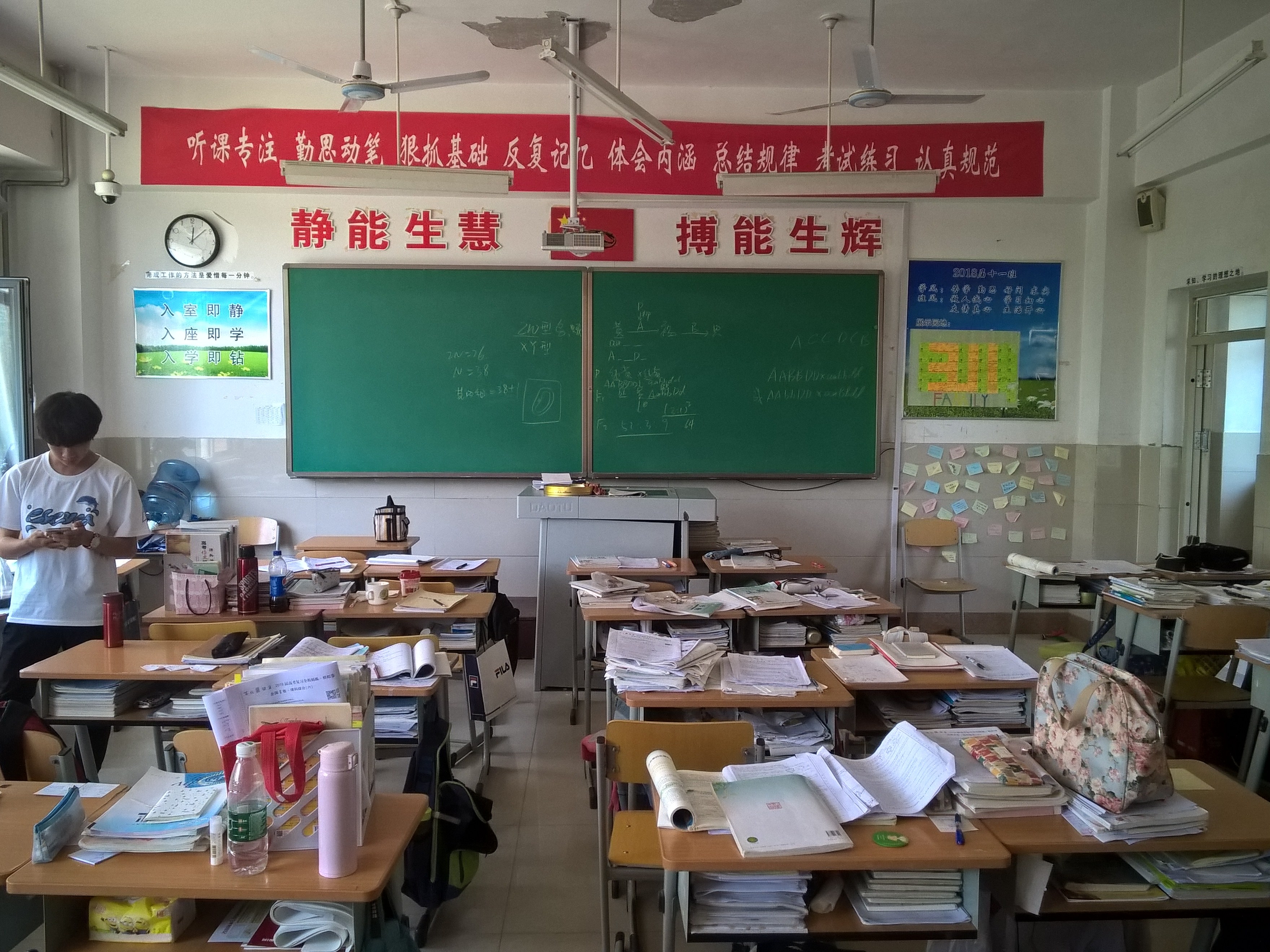
Cover photo: A view of a classroom in Tieling High School 01 — Kychn / Wikimedia Commons, licensed CC BY-SA 4.0 (cropped; license: https://creativecommons.org/licenses/by-sa/4.0).