From one-in-seventeen to a Demo Day footnote
Four years after African founders made up roughly one in seventeen companies in a Y Combinator batch, the continent has become a footnote at Demo Day. In early 2022, YC's Winter batch included 24 African startups, 18 of them Nigerian — the first time an African country ranked third in a cohort, behind only the United States and India. By Winter 2023 the African count had fallen to three; Winter 2024 admitted four (Nigerian fintechs Cleva and Miden, Kenya's Triply and Zimbabwe's Ocular AI) out of 260 companies chosen from more than 27,000 applications. A search for African startups across the twelve batches since returns nothing.
Africa's share of a batch has shrunk from about six per cent at the peak to around one per cent by Winter 2024, according to a Disrupt Africa analysis published November 25. Across fourteen years, YC has backed roughly 100 African startups since Wave in 2012 — about two per cent of a portfolio of more than 4,600 companies. Nigeria accounts for around 40 per cent of them, Egypt about 15 per cent, Kenya about 14 per cent, and more than half are fintechs. The 2021–22 surge, in this reading, was the anomaly — not the decline.
What changed: a YC that wants different companies, in San Francisco
The analysis attributes the pullback to three forces moving at once. First, YC returned to physical programmes: after fully remote batches from Summer 2020 opened the door to Lagos and Nairobi founders, the programme now runs mainly on its San Francisco campus for three months — meaning a US visa, a quarter away from customers and staff, and Bay Area rents paid from a pre-seed budget. Second, the intake profile has shifted toward AI companies selling to other businesses: 62 per cent of the Spring 2026 cohort was B2B, and the Summer 2026 batch focused on infrastructure for AI agents, with consumer companies at about five per cent — a poor fit for the fintech and consumer-marketplace companies that made up Africa's YC alumni.
Third, the standard deal has grown to $500,000 ($125,000 for seven per cent plus a $375,000 uncapped SAFE) with Delaware incorporation required — a bigger cheque on an uncapped note that is effectively a bet on US-scale outcomes, raising the bar for businesses whose ceiling is set by Nigerian or Kenyan purchasing power. YC's move to four batches a year in 2025 gives African founders more application windows, but no visible rebound in admissions has followed.
On the African side, the continent's funding downturn made the retreat easier: startup funding fell 27.8 per cent to $2.4 billion in 2023 and a further 53.5 per cent in 2024 to $1.12 billion, recovering to $1.6 billion in 2025 — a recovery skewed to large rounds, not the deep seed pool YC's Demo Day model depends on. Currency did the rest: with the naira losing most of its post-2023-reform value and the Egyptian pound repeatedly devalued, startups earning local currency but valued in dollars saw the metric YC investors care about shrink. Nigeria, which supplied 18 of the 24 African companies at the 2022 peak, took the hardest hit.
AI-assisted analysis
Machine-synthesised- Figure
Y Combinator's Winter 2022 batch included 24 African startups, 18 of them Nigerian — the first time an African country ranked third in a cohort behind the US and India — but Winter 2023 admitted three and Winter 2024 four (Cleva, Miden, Triply, Ocular AI) out of 260 companies from more than 27,000 applications, with none in the twelve batches since.
Source: Disrupt Africa(opens in a new tab) - Figure
Africa's share of a YC batch fell from about six per cent at the peak to around one per cent by Winter 2024; YC has backed roughly 100 African startups since Wave in 2012, about two per cent of a portfolio of more than 4,600 companies, with Nigeria around 40 per cent, Egypt about 15 per cent, Kenya about 14 per cent, and more than half fintechs.
Source: Disrupt Africa(opens in a new tab) - Figure
African startup funding fell 27.8 per cent to $2.4 billion in 2023 and a further 53.5 per cent to $1.12 billion in 2024, recovering to $1.6 billion in 2025 with money skewing to large rounds; YC's standard deal is now $500,000 ($125,000 for seven per cent plus a $375,000 uncapped SAFE) with Delaware incorporation required.
Source: Disrupt Africa(opens in a new tab) - Figure
The YC badge was worth more than the cheque to African founders: Briter Bridges counted about $1.3 billion in follow-on funding raised by YC's African portfolio by 2021, and Paystack's $200 million sale to Stripe in 2020 remains the benchmark exit; home-grown alternatives include Accelerate Africa, Madica, Katapult Africa and Antler residencies, while Google's equity-free Africa programme drew nearly 2,600 applicants for 15 places in 2026.
Source: Disrupt Africa(opens in a new tab)
Synthesised by PulseGrid's editorial AI from the sourced claims in this article and reviewed by PulseGrid AI Desk. How we use AI.
Partner content · paid placement
Sponsored tile inventory: Q1 2027
Native tiles in the in-feed carousel and the article block, sold only with the visible Sponsored / Partner Content label. Slot sizes, positions and advertiser terms are published on the advertise page. No newsroom byline is ever attached to partner copy.
The badge was worth more than the cheque
Fewer YC slots cost African founders more than the money. The badge worked as a signal that let a first-time Lagos founder raise from US investors who had never heard of them; Briter Bridges counted about $1.3 billion in follow-on funding raised by YC's African portfolio by 2021. Of the roughly 100 African YC companies, the ones that returned real capital or reached meaningful scale are a short list — Paystack, Flutterwave, Wave, Nomba and Reliance Health — and Paystack's $200 million sale to Stripe in 2020 remains the benchmark exit, six years old. At least five YC-backed African startups are formally inactive in the accelerator's directory.
Local alternatives can now match the cheque but not yet the network. Iyin Aboyeji's Future Africa runs Accelerate Africa, openly pitched as a home-grown YC answer, taking no equity on entry and investing $250,000–$500,000 after due diligence. Madica writes up to $200,000 on a SAFE; Katapult Africa invests $150,000–$500,000 in agri-, food- and climate-tech; Antler runs residencies in Nairobi and Lagos. Google's equity-free Africa programme drew nearly 2,600 applicants for 15 places in 2026. But the broader accelerator map is shrinking too — Techstars closed its Lagos programme in late 2024 after two cohorts, and Founders Factory Africa shut in 2025.
YC itself is still present, just differently: it took part in follow-on rounds for Chowdeck's Series A and Breadfast in 2025 — backing what it already owns rather than buying new tickets in Africa.
What to watch
The Fall 2026 Demo Day on December 2 — the next visible test of whether four-batches-a-year and AI-infra intake reopen the door to African teams building for global B2B customers.
Whether the replacement capital stack — Accelerate Africa, Madica, Katapult, Antler and the recent fund cluster — can replicate the YC badge's signal function for first-time founders raising from US investors.
Whether the late-stage skew in Africa's funding recovery leaves the median first-time founder stranded at the exact stage YC used to serve.
Bottom line
The YC badge was African tech's most important signal mechanism, and its retreat to roughly one per cent of batch is a structural re-anchoring of how the continent's founders reach global capital. The Disrupt Africa analysis frames the question in the right direction: with local capital deeper, local accelerators more credible, and a generation of YC alumni now writing cheques at home, Africa's next Paystack may not need Y Combinator at all — whether YC adapts fast enough to find it first is YC's problem, not Africa's. The counts and portfolio figures in this piece are Disrupt Africa's and Briter Bridges', and deserve the attribution they carry.
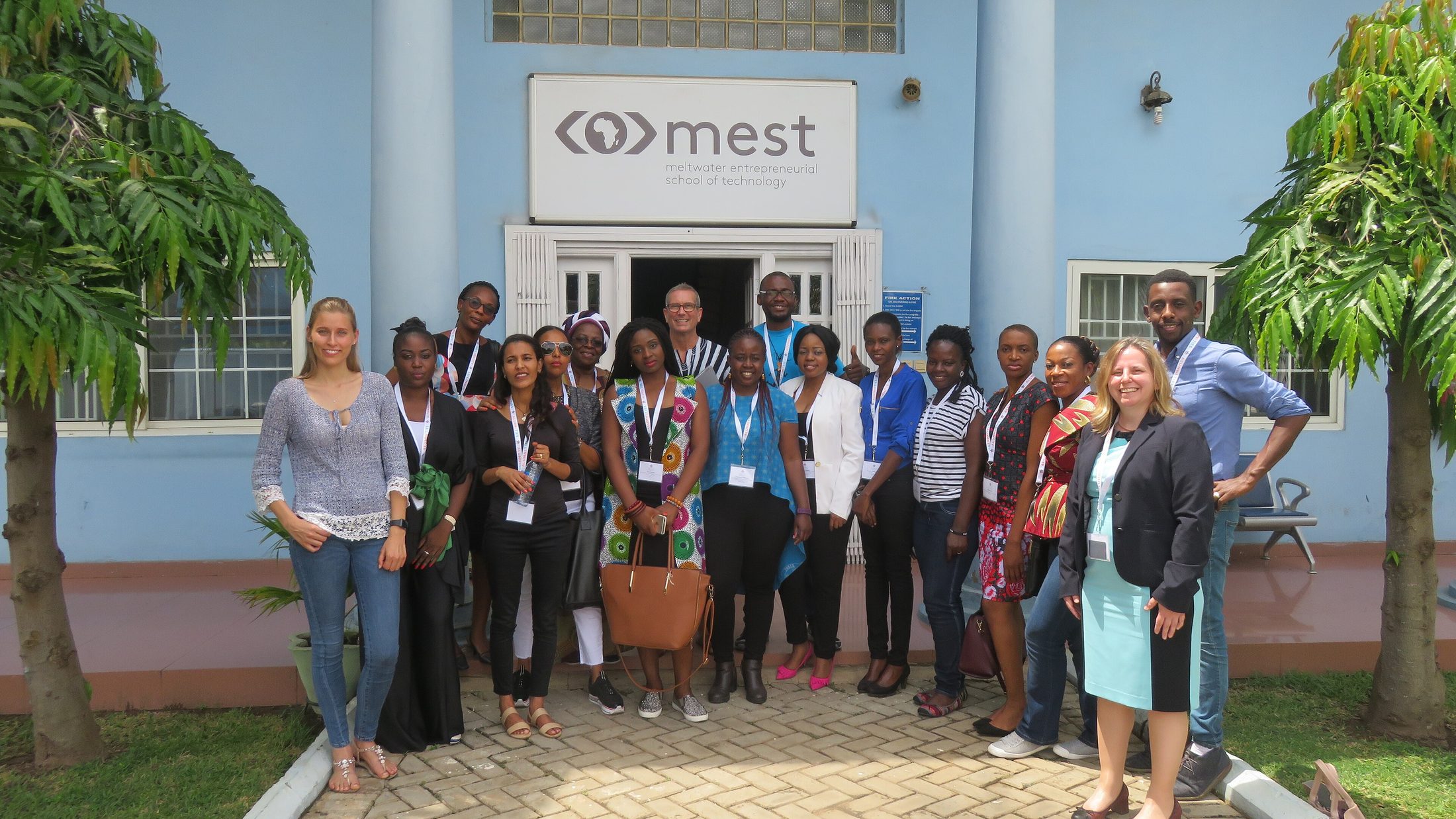
Cover photo: Africa Alumni TIES – Accra meltwater-entrepreneurial-school-of-technology-incubator-mest 48259471807 o (53873201312).jpg — Exchanges Photos / Wikimedia Commons, licensed CC0 (cropped; license: https://creativecommons.org/publicdomain/zero/1.0).