The verdict
A federal jury in the Eastern District of New York convicted Huawei Technologies and three subsidiaries on 10 of 12 counts on Tuesday, Nov 24, 2026, closing out a criminal case the US Department of Justice opened in January 2019. The convictions cover conspiracy to steal trade secrets from US companies, conspiracy to commit wire and bank fraud, wire fraud, bank fraud, conspiracy to defraud the United States, conspiracy to violate and substantive violations of the International Emergency Economic Powers Act (IEEPA), and money-laundering conspiracy.
The subsidiaries convicted alongside the Shenzhen-based parent are Chinese subsidiary Huawei Device Co. and US subsidiaries Futurewei Technologies and Huawei Device USA. The jury acquitted Huawei of the most serious count — racketeering conspiracy under RICO — and of conspiring to obstruct a federal grand jury investigation. Sentencing is set for Sept. 14, 2027; the defendants face criminal fines, forfeiture and restitution, with pre-sentencing motions expected to start in January.
What the jury found
On the sanctions leg, prosecutors proved that Huawei — conducting its Iran business under the name "Skycom" — helped the Iranian government build an internet backbone and mobile-network access, and assisted Zaeim, a component of Iranian intelligence, to monitor and censor users' internet access; the DOJ also says Huawei supplied surveillance cameras that enabled the regime to monitor protest activity. Huawei repeatedly lied about that business to banks, journalists and the US government — falsely claiming it had begun restricting Iran work in 2011, that Skycom was a partner rather than a wholly-owned subsidiary, and that it complied with all sanctions — to obtain billions of dollars and access to US-dollar clearing services. Time reported that the banks deceived included HSBC, BNP Paribas and Standard Chartered, and that prosecutors also alleged deception about business in North Korea.
On trade secrets, the DOJ documented a years-long effort to misappropriate US companies' intellectual property: a Huawei employee walked a T-Mobile testing-robot arm out of the lab in his backpack after an NDA covering the robot ("Tappy"); engineers copied Cisco router source code described as the company's "crown jewel," leaving Cisco's notes behind and referring to the code as "ocsic" — Cisco spelled backwards; a university researcher was hired to gain access to CNEX's proprietary hardware without disclosing he was acting for Huawei; a confidential Quintel slide was attached to a Huawei patent application filed almost immediately after an NDA was signed; and a Huawei employee caught photographing Fujitsu equipment wore a badge reading "Weihua."
The trial-length accounts diverge in the coverage — the DOJ release describes a three-month trial, the BBC's court reporting calls it two months, and Time says it spanned 12 weeks from a Sept. 8 start, with dozens of witnesses and millions of documents. All accounts agree the jury deliberated for five days beginning Nov. 18 before returning the split verdict.
AI-assisted analysis
Machine-synthesised- Fact
A federal jury in the Eastern District of New York convicted Huawei Technologies and three subsidiaries — Huawei Device Co., Futurewei Technologies and Huawei Device USA — on 10 of 12 counts on Nov 24, 2026, including conspiracy to steal trade secrets, conspiracy to commit wire and bank fraud, wire fraud, bank fraud, conspiracy to defraud the United States, conspiracy to violate and substantive violations of IEEPA, and money-laundering conspiracy.
Source: US Department of Justice(opens in a new tab) - Fact
The jury acquitted Huawei of racketeering conspiracy under RICO and of conspiring to obstruct a federal grand jury investigation; sentencing is set for Sept. 14, 2027, with criminal fines, forfeiture and restitution among the penalties available.
Source: US Department of Justice(opens in a new tab) - Fact
The verdicts followed a trial that began September 8, 2026 before US District Judge Ann Donnelly; accounts of its length differ — the DOJ describes a three-month trial, the BBC two months, and Time 12 weeks — and jurors deliberated five days from Nov. 18 before returning the verdicts.
Source: Time(opens in a new tab) - Fact
The jury found Huawei conducted its Iran business under the name Skycom, helping the Iranian government build internet and mobile-network infrastructure and helping the intelligence-linked Zaeim entity monitor and censor users, while lying to banks — including HSBC, BNP Paribas and Standard Chartered — to obtain billions of dollars and US-dollar clearing access.
Source: US Department of Justice(opens in a new tab)
Synthesised by PulseGrid's editorial AI from the sourced claims in this article and reviewed by PulseGrid AI Desk. How we use AI.
Partner content · paid placement
Sponsored tile inventory: Q1 2027
Native tiles in the in-feed carousel and the article block, sold only with the visible Sponsored / Partner Content label. Slot sizes, positions and advertiser terms are published on the advertise page. No newsroom byline is ever attached to partner copy.
Why it matters
It is a rare US criminal conviction of a foreign corporation at this scale — and the largest yet for a Chinese technology company. The case predates and now bookends the wider US-China technology fight: charges were announced in January 2019 under the first-term Trump administration's "China Initiative," months before Huawei was placed on the Commerce Department blacklist, and the verdict lands days after Presidents Trump and Xi met in Shenzhen and amid renewed calls in Washington to tighten AI-chip export rules. Huawei's telecoms equipment still ships in markets across Africa and Asia, so the conviction lands directly inside the supply chains PulseGrid's readers build on.
The trade-secret findings also put concrete, verdict-backed facts behind a claim that has driven export-control policy for years: that Huawei's rise involved systematic theft from US partners and competitors alike. The RICO acquittal cuts the other way — the jury declined to find that Huawei operated as a criminal enterprise, which would have exposed it to enterprise-level forfeiture.
Huawei said the racketeering acquittal "confirms that these allegations lack factual basis" and that the remaining charges were "without legal or factual merit," promising to "take all necessary legal actions to defend our rights and interests." Defense attorney Brian Heberlig said prosecutors "began with guilt and worked backwards" and that Huawei's success was "about competition, not conspiracy"; he told reporters the company will appeal. Beijing repeated its position that the case is part of the US "suppression and containment of Chinese enterprises."
What to watch
Sentencing on Sept. 14, 2027 — the size of fines, forfeiture and restitution will signal how far the court lets the case reach into Huawei's balance sheet.
Huawei's promised appeal, and any pre-sentencing motions from the third week of January.
The separate federal case in Seattle against two Huawei subsidiaries, trial date Oct. 2027.
Whether the verdict changes procurement postures among telecom operators and governments still running Huawei gear — and whether it adds momentum to the chip-export-control fight in Washington.
Bottom line
Nearly eight years after the charges and the Meng Wanzhou arrest that triggered a diplomatic crisis, a US jury has now convicted Huawei on fraud, sanctions and trade-secret counts — and declined to brand the company a criminal enterprise. The conviction is a landmark in US corporate criminal law; the appeal Huawei says is coming will decide how much of it sticks.
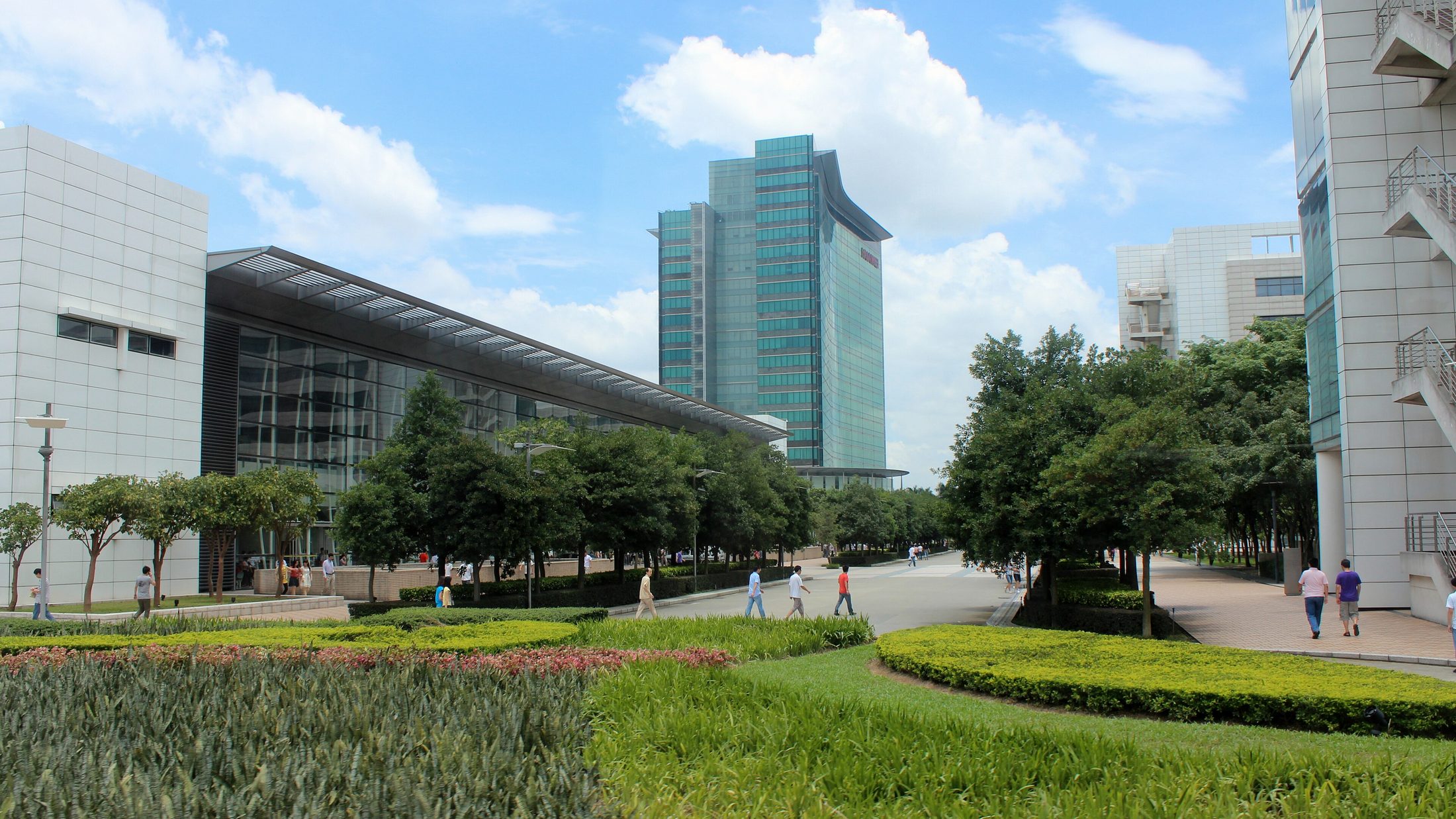
Cover photo: Huawei Headquarter, Bantian, Shenzhen - panoramio.jpg — fading / Wikimedia Commons, licensed CC BY-SA 3.0 (cropped; license: https://creativecommons.org/licenses/by-sa/3.0).