The new bidder at the utility
For decades, steelmakers were often among the largest customers of electric utilities. That status is being overtaken. “There are locations in the United States that have electricity shortages because the data centers compete against other large electricity users for a limited supply, and that affects the steel companies too, because you need a lot of electricity to make steel,” Adina Renee Adler, executive director of the Global Steel Climate Council (GSCC), told Fastmarkets in an interview published November 23 (conducted Thursday November 12).
The squeeze has two sides, Adler said: surging electricity demand from data centers coincides with delays to new generation projects — particularly renewables — and some data centers are willing to pay higher electricity prices, potentially putting steelmakers at a disadvantage when competing for access to power.
A policy stack moving in both directions
The timing collides with a US energy-policy transition. The Trump administration has moved to halt or reconsider approvals for several renewable-energy projects, particularly offshore wind, while policy and regulatory uncertainty has complicated the outlook for new wind and solar capacity — exactly the capacity growth Adler says is needed. “We need all sources of energy,” she said, adding that generation needs to expand to keep pace with demand.
Democrats' capture of both chambers of Congress in the November midterm elections could reshape US energy policy when the party takes control in January 2027, though legislation would still need bipartisan support and the president's signature. Meanwhile the bipartisan American Affordability and Jobs Act of 2026 — introduced September 30, with a substitute amendment released November 7 and the Trump administration's endorsement on November 9 — seeks to streamline federal permitting and environmental reviews for energy and infrastructure projects. “We are behind it 100%,” Trump told reporters when asked about the legislation in early November.
If you can't beat them, wire into them
The pressure is prompting some steelmakers to explore alternative ways of securing power — including potential cooperation with data-center operators and dedicated generation located near steelmaking facilities. Some companies are considering partnerships with large data-center operators to negotiate electricity prices collectively: by approaching utilities as two large, long-term customers, steelmakers and data-center operators could strengthen their negotiating position. “I think it's already happening,” Adler said, while cautioning such arrangements may not suit every region.
AI-assisted analysis
Machine-synthesised- Quote
Adina Renee Adler, executive director of the Global Steel Climate Council, told Fastmarkets that some US locations face electricity shortages because data centers compete against other large electricity users for limited supply — “because you need a lot of electricity to make steel.”
Source: Fastmarkets(opens in a new tab) - Fact
Surging data-center electricity demand is coinciding with delays to new generation projects, particularly renewables, and some data centers are willing to pay higher electricity prices — potentially putting steelmakers at a disadvantage in competing for access to power.
Source: Fastmarkets(opens in a new tab) - Fact
The Trump administration has moved to halt or reconsider approvals for renewable projects including offshore wind; Democrats' capture of both chambers of Congress reshapes energy policy from January 2027; and the bipartisan American Affordability and Jobs Act of 2026 (introduced Sep 30, substitute amendment Nov 7, Trump endorsement Nov 9 — “We are behind it 100%”) would streamline federal permitting for energy and infrastructure projects.
Source: Fastmarkets(opens in a new tab) - Fact
Some steelmakers are exploring cooperation with data-center operators — including collectively negotiating electricity prices as two large long-term customers — and dedicated generation near steelmaking facilities; Adler said of such arrangements “I think it's already happening.” Nucor signed an MOU with NuScale Power in 2023 to study co-locating SMRs with its electric-arc furnace mills, which remains exploratory.
Source: Fastmarkets(opens in a new tab)
Synthesised by PulseGrid's editorial AI from the sourced claims in this article and reviewed by PulseGrid AI Desk. How we use AI.
Partner content · paid placement
Sponsored tile inventory: Q1 2027
Native tiles in the in-feed carousel and the article block, sold only with the visible Sponsored / Partner Content label. Slot sizes, positions and advertiser terms are published on the advertise page. No newsroom byline is ever attached to partner copy.
Dedicated generation is the other route. Nucor signed a memorandum of understanding with NuScale Power in 2023 to study co-locating small modular reactors with its electric-arc furnace steel mills — an agreement that remains exploratory and is not a commitment to build a reactor. The stakes are structural: electric-arc furnaces account for approximately 72% of US domestic raw-steel production, and EAF mills — while generally emitting less CO2 than integrated blast-furnace operations — rely heavily on electricity, making their costs and emissions profiles sensitive to power prices and the generation mix.
What to watch
Whether the American Affordability and Jobs Act advances in the lame-duck session or the new Congress — and whether data-center demand is written into its fast-track permitting logic.
Concrete steel-maker/data-center power agreements: collective-negotiation partnerships and dedicated generation near mills, beyond the exploratory Nucor–NuScale MOU.
Where electricity-shortage regions land on the allocation question — if data centers can outbid industrial users, what regime replaces the highest bidder?
Bottom line
The AI buildout's binding constraint has moved from chips to generation — and the first traditional industry to feel it is steel, the archetypal large electricity user. When mills start negotiating joint power deals with data centers or siting their own reactors, electricity scarcity is no longer an abstract grid story; it is a reallocation of industrial advantage.
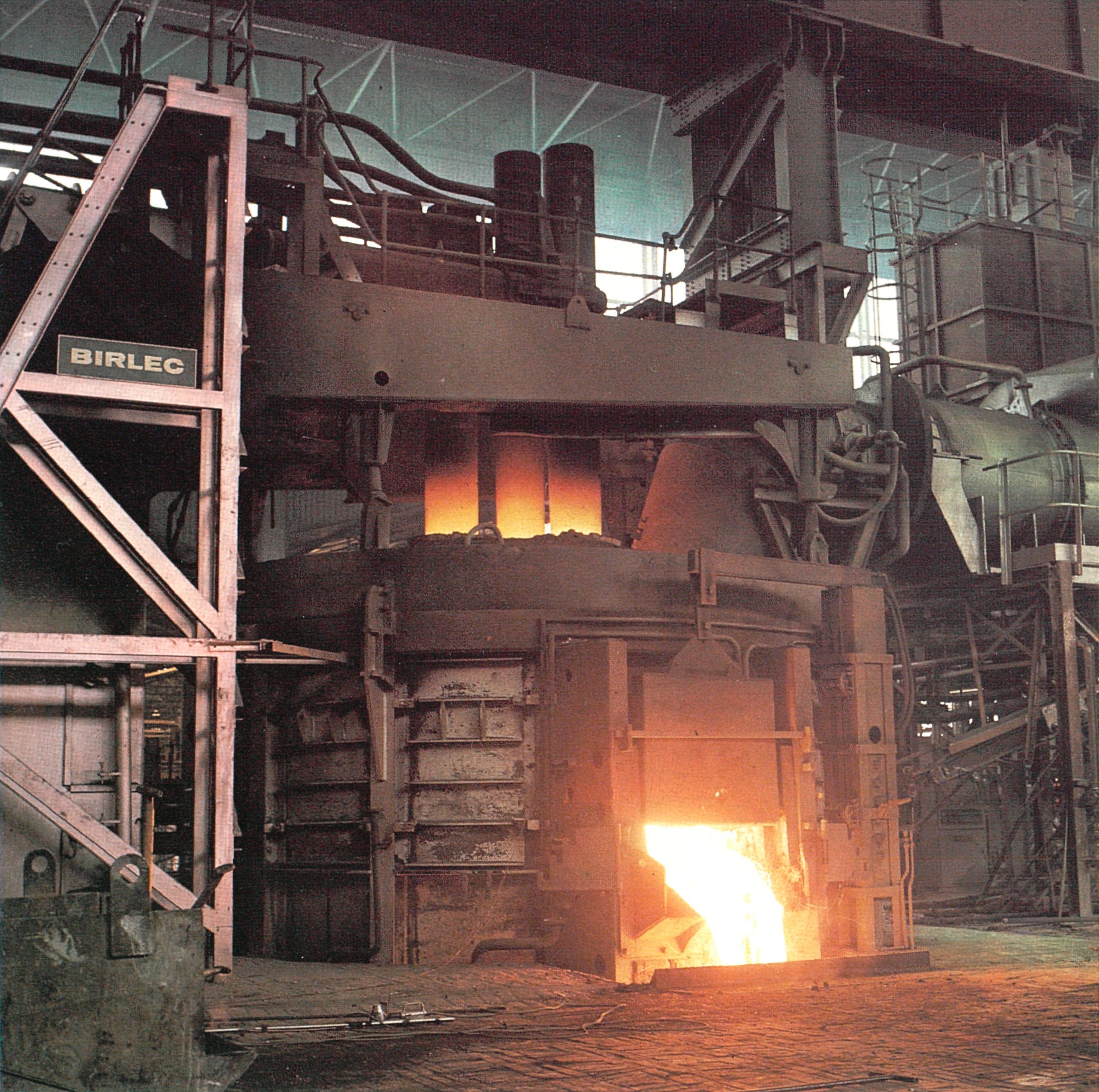
Cover photo: ECSC Financial report 1975 Clydesdale Tube Works EAF — European Coal and Steel Community / Wikimedia Commons, licensed CC BY-SA 4.0 (cropped; license: https://creativecommons.org/licenses/by-sa/4.0).