The project
A consortium led by Vitol's Engen unit — with VTTI, Vitol itself and Saudi Arabia's ACWA Power — expects to begin construction of a 40 billion rand ($2.3 billion) integrated LNG-to-power project at the east-coast port city of Durban in late 2028, the commodities trader said in a statement on Monday.
The development bundles three things: a liquefied natural gas import terminal with peak regasification capacity of approximately 5 billion cubic metres per annum, associated pipeline infrastructure, and a 1.9-gigawatt combined-cycle gas turbine power plant. The stated purpose is to help South Africa meet demand as gas feedstock from Mozambique — currently the source of most of the country's domestic gas — rapidly declines, and to anchor an energy mix that replaces the coal-fired stations providing the bulk of electricity in Africa's most industrialised economy.
The gate
The build is not yet committed. Vitol's statement makes the project "subject to successful participation in South Africa's second gas-to-power procurement round" — plus all relevant regulatory and environmental approvals. That qualifier carries unusual weight, because the first round collapsed. South Africa's debut tender for private producers to generate 2,000 MW closed on Oct 28 without a preferred bidder being selected, the energy ministry said: after multiple delays, the Independent Power Producer Office had received four bids in May totalling 2,830 MW, but the request for proposals required bidders to provide assurances of gas supply and they were unable to do so.
The Industrial Gas Users Association of Southern Africa called that failure a "disaster", with gas users scrambling to secure alternative supplies ahead of 2028 and 2030 deadlines and, by the association's account, roughly 75,000 direct jobs and some 700 billion rand ($42 billion) in annual economic activity on the line. At the time of the October failure there was no indication of when the next procurement window would open — and the Durban consortium's late-2028 construction start now depends on it.
Why it matters beyond the port
South Africa is where the African compute buildout meets the continent's firm-power question. Data-centre and AI-infrastructure announcements for the country multiply every quarter, but megawatts are gated by procurement rounds like this one — and the first round's failure shows that gas-supply assurance, not capital or appetite, is the binding constraint. A 1.9GW plant and a regasification terminal at Durban would be among the largest single injections of new firm capacity on the table; whether it arrives depends on a tender process that has already produced zero bidders once.
AI-assisted analysis
Machine-synthesised- Fact
A consortium led by Vitol's Engen unit — including VTTI, Vitol and Saudi Arabia's ACWA Power — expects to begin construction of a 40 billion rand ($2.3 billion) integrated LNG-to-power project in Durban, South Africa, late in 2028, according to a company statement on Monday Nov 23, 2026.
Source: Reuters(opens in a new tab) - Figure
The Durban project comprises a liquefied natural gas import terminal with peak regasification capacity of approximately 5 billion cubic metres per annum, associated pipeline infrastructure, and a 1.9-gigawatt combined-cycle gas turbine power plant, and is subject to successful participation in South Africa's second gas-to-power procurement round plus regulatory and environmental approvals.
Source: Reuters(opens in a new tab) - Fact
South Africa's first gas-to-power tender — for 2,000 MW from private producers — closed on Oct 28, 2026 without a preferred bidder being selected because bidders could not provide the required gas-supply assurances; the Independent Power Producer Office had received four bids totalling 2,830 MW in May after multiple delays.
Source: Reuters(opens in a new tab) - Quote
The Industrial Gas Users Association of Southern Africa called the tender failure a "disaster", with roughly 75,000 direct jobs and 700 billion rand ($42 billion) in annual economic activity at stake ahead of 2028 and 2030 supply deadlines; South Africa imports most of its gas from Mozambique, where declining volumes are expected to run dry in a few years.
Source: Reuters(opens in a new tab)
Synthesised by PulseGrid's editorial AI from the sourced claims in this article and reviewed by PulseGrid AI Desk. How we use AI.
Partner content · paid placement
Sponsored tile inventory: Q1 2027
Native tiles in the in-feed carousel and the article block, sold only with the visible Sponsored / Partner Content label. Slot sizes, positions and advertiser terms are published on the advertise page. No newsroom byline is ever attached to partner copy.
The sequencing matters for anyone timing compute investment: the consortium wants to start construction in late 2028, the first round's failures centre on gas supply running dry in the same window, and Mozambique's decline is the reason the terminal is being proposed at all. Imported LNG is South Africa's answer to a feedstock cliff — but the answer is still one procurement round away from being real.
What to watch
The opening and terms of South Africa's second gas-to-power procurement round — including whether bidders are required to show the gas-supply assurances that sank the first.
Regulatory and environmental approvals for the Durban terminal, and any schedule movement on the "late 2028" construction start.
Competing supply plays — the ExxonMobil-Eskom anchored first LNG import terminal — and whether two import terminals can both clear South Africa's gas economics.
Whether the 2028 and 2030 industrial-user deadlines force emergency measures before any new capacity lands.
Bottom line
The Durban project is the largest concrete answer yet to South Africa's gas feedstock cliff — and its own launch condition is a procurement round whose predecessor failed on exactly the thing a gas-to-power project lives or dies by: assured gas supply. $2.3 billion and 1.9GW are now penciled in behind a gate that has already disappointed once. For the compute buildout watching South Africa's megawatts, the second round is the number to watch.
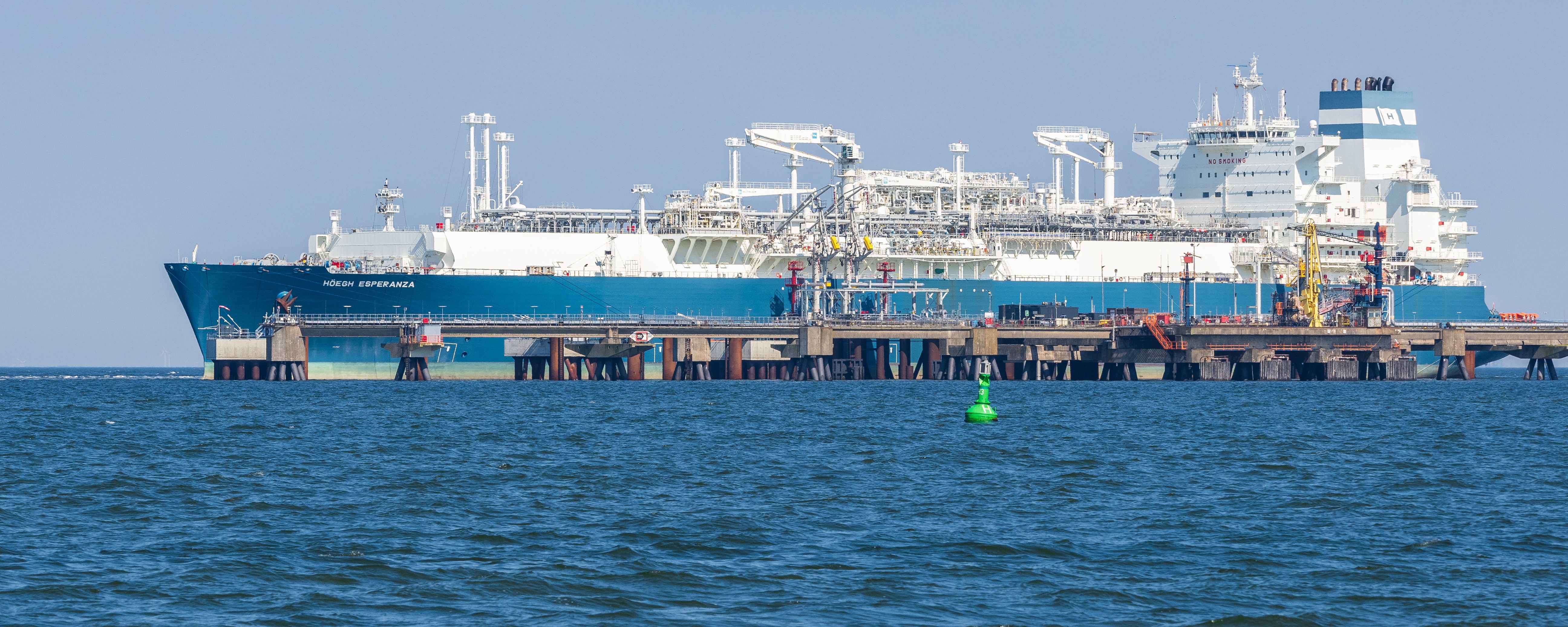
Cover photo: FSRU-Schiff "Höegh Esperanza" in Wilhelmshaven (2024) — JoachimKohler-HB / Wikimedia Commons, licensed CC BY-SA 4.0 (cropped; license: https://creativecommons.org/licenses/by-sa/4.0).